Light and Weather
Anticyclonic gloom is not a wasted day
Flat grey cloud is a very large softbox, and it suits woodland, water and stone far better than a clear sunrise does. What to point it at instead of going home.
Published 9 July 2026 Anywhere in Britain, most winters Field entry
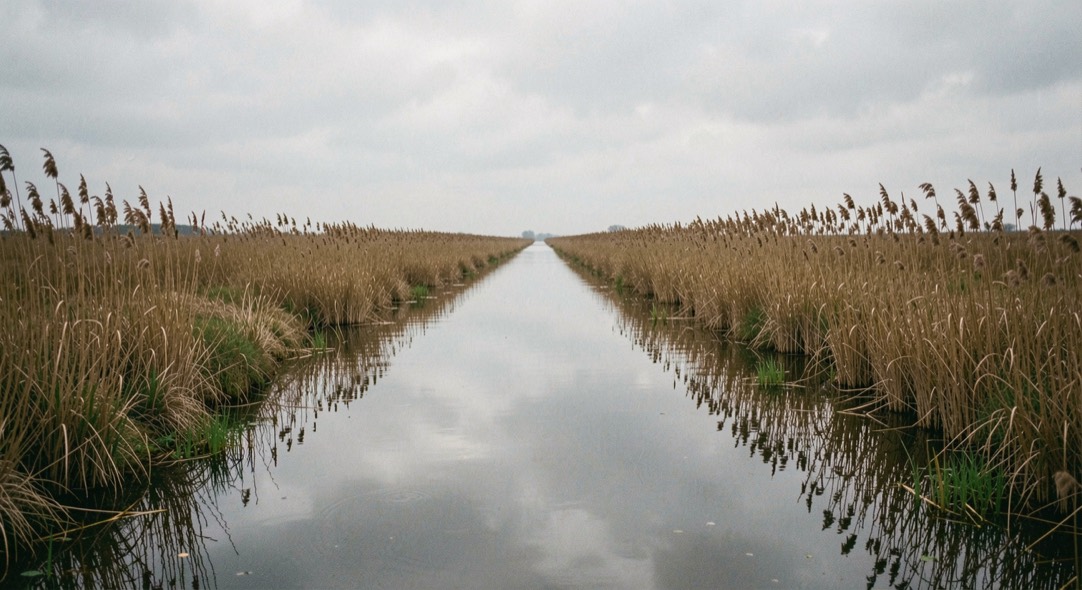
Anticyclonic gloom is a real term and a real condition. High pressure sits over the country, the air sinks, and the sinking air warms as it descends and forms an inversion a few hundred metres up: a lid, with warmer air above and cooler moist air trapped below. Everything under that lid stays put, including the moisture, and it condenses into an unbroken sheet of low cloud. There is no wind, no rain, no sun and no prospect of any of them for days. Most people look at that forecast and stay at home. That is a mistake, and this entry is about why.
What the light is actually doing
An unbroken layer of stratocumulus a few hundred metres above the ground is a light source the size of the sky, at very close range, with a diffuser in front of it. In studio terms it is an enormous softbox directly overhead. Shadows are almost absent, the dynamic range of the scene collapses to something a sensor handles without complaint, and colour saturation goes up rather than down because there is no specular glare bleaching the surfaces.
Two consequences follow. The first is that any subject whose problem is contrast becomes easy: woodland interiors, gorges, north facing crags, anything under a canopy. The second is that any subject whose interest is shape rather than texture becomes hard, because without shadow there is nothing to model the form. Hills go flat. Dunes go flat. Tors go flat, as set out in the entry on why noon is the wrong hour on Dartmoor granite, and a grey day is noon all day.
So the rule is not that flat light is bad. The rule is that flat light changes the list of subjects, and the photographers who go home are the ones who arrived with only one list.
The list that suits it
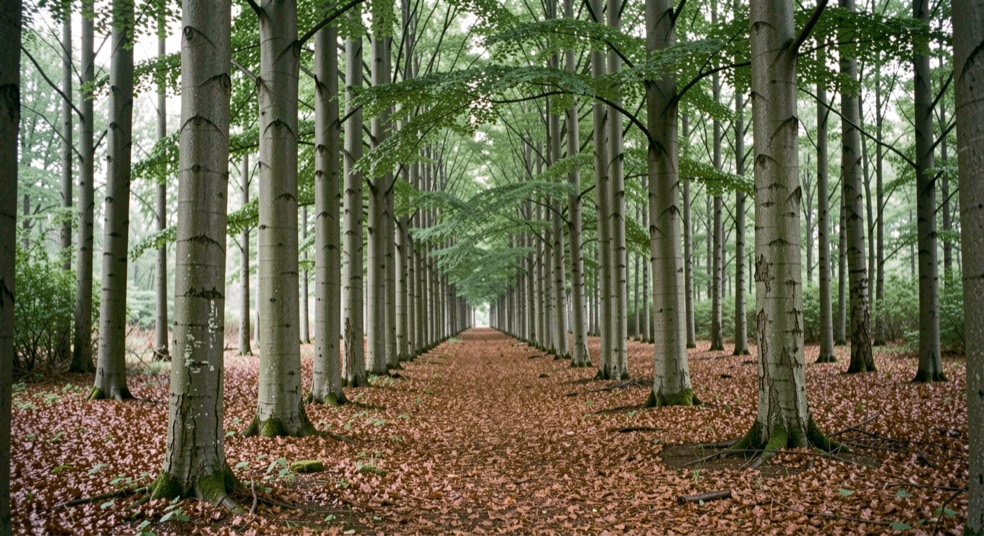
Woodland comes first and by some distance. Sunlight in a wood produces a mess of blown highlights and black holes; grey cloud produces an even, readable space in which the trunks separate by tone. A wood photographed under a bright sky is nearly always a worse picture than the same wood photographed under cloud, and this is the one condition where that can be said without qualification.
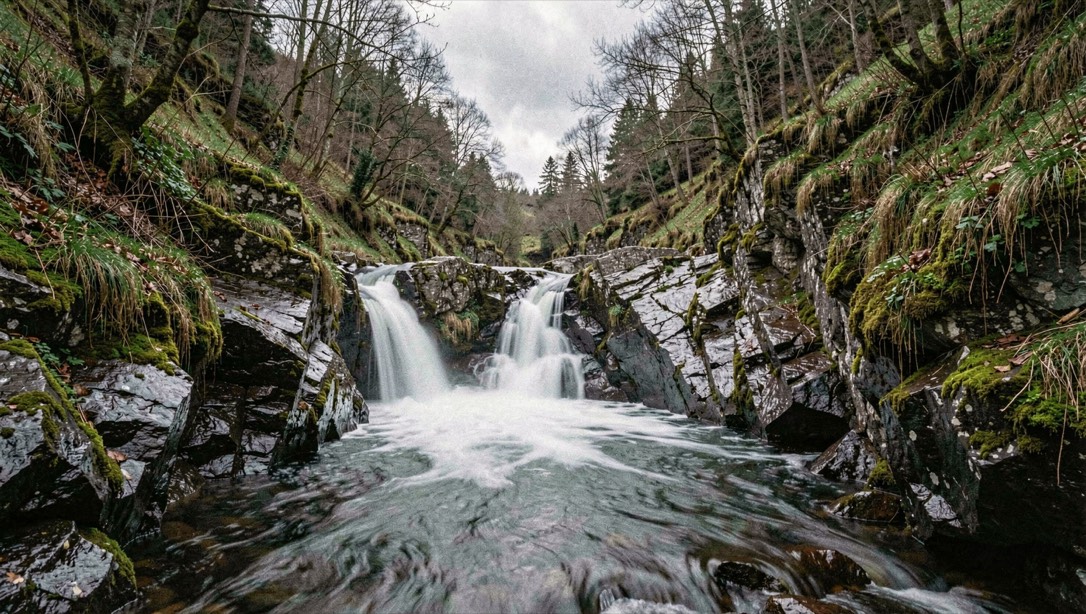
Water in enclosed places comes second. Waterfalls, becks in a gorge, mill leats, anywhere the water is dark and moving: flat light makes the white of the water the only bright thing in the frame, and the shutter can be left open for a second or two without any risk of blowing it. In the limestone dales of the Pennines this is the standard working condition rather than a consolation prize.
Wet stone comes third. Rock that is dry and grey under sun becomes dark, saturated and full of colour under cloud and rain, and lichen, which is nearly invisible in bright light, comes forward. Fourth is anything reflective and flat: fen drains, canals, tarns, wet sand, all of which mirror a featureless sky as a clean pale field and turn into graphic pictures with almost nothing in them.
On the ground
A polariser earns its place on days like this, and for the opposite reason to the usual one. It is not there to deepen a blue sky, since there is not one; it is there to take the sheen off wet leaves, wet rock and the surface of water, which under diffuse light is a broad dull glare rather than a set of highlights. Turning it while looking through the finder shows the change immediately.
Exposure runs high, not low. A grey scene metered automatically comes back grey and heavy. Half a stop to a stop of extra exposure, kept clear of clipping, is what produces the luminous version rather than the flat one.
Composition when there is no sky
The single most useful decision on a gloom day is to exclude the sky entirely. A featureless white band across the top of a frame is dead area and it also drags the exposure around. Point the camera downhill, into the trees, at the water, along the wall. If the sky must be in, give it as little room as possible and make sure something with an edge, a ridge line or a line of trees, sits against it.
The second is to work closer than usual. Grand vistas need light to structure them and there is none; a group of three trunks, a bend in a beck, a section of drystone wall with the ground behind it, all hold up because they rely on tone and texture rather than on drama. This is the day for the long lens and for the picture that could have been made anywhere and still works.
The third is to accept the palette. Under this light Britain is green, brown, grey and rust, and pushing it toward warmth in processing looks exactly like what it is. The pictures that hold up from these days are the ones that stayed cool and let the colour be as muted as it was on the ground.
Knowing it is coming, and knowing when it will break
Anticyclonic gloom is easy to spot on a pressure chart: a large high with widely spaced isobars sitting over or just to the east of the country, no fronts within reach, and light winds. Reading that off the chart the night before is covered in the reference note on synoptic charts, which also covers the more interesting case, the ridge of high pressure that follows a cold front through and gives clear air with showers still around.
The condition breaks in one of two ways. Either the high moves off and a front arrives, in which case the last hours before the rain are frequently the best of the week, or the cloud layer thins from the edges and lifts, which on the right ground gives a valley inversion instead of a general grey. That second outcome, and the conditions that make cold air pool in a valley bottom overnight, is the subject of the entry on frost hollows and inversions.
It is also the light in which flat coastal ground works best. Marsh, mud and creek all read as tone rather than shape, which is precisely what a grey sky gives; that case is made in the entry on photographing the Norfolk saltmarsh.
Flat grey skies flatten a scene, but they do not empty it. Tone is what remains: the slow gradation from a dark hedgerow to a pale field, the way a wet lane holds a slightly deeper value than the grass beside it. Painting that range by hand, rather than trusting the camera to record it, is one way to keep looking when the light gives nothing dramatic. A sheet of paper and a loaded brush make the same demand as the viewfinder: decide what sits forward and what recedes. The method is set out in glazing and building depth in layers, which deals with washes, layering and the point where a passage turns muddy.