Light and Weather
River light in a steep valley: reading water the way a wading angler does
In a steep valley the river runs through a moving corridor of light, and the corridor follows the sun, not the photographer's convenience. A field note on water reading borrowed from the wading anglers.
Published 12 September 2026 Appalachia borrowed, Exe and Barle at home Field entry
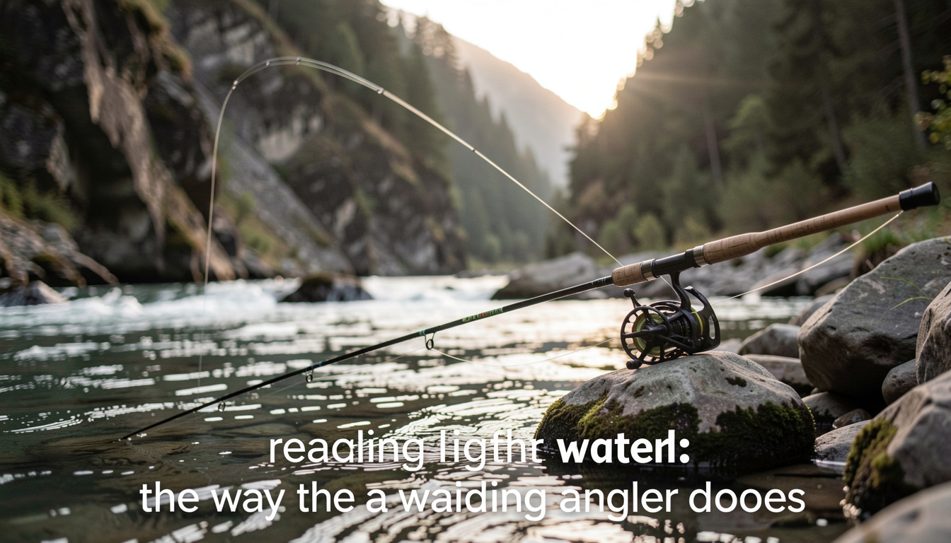
The short answer is that a steep valley does not have golden hour, it has a golden slot. The sun clears the eastern rim late, crosses the water in a moving band, and drops behind the western wall while the sky is still blue. If you arrive by the clock you miss it; if you arrive by the geometry you are standing in the slot when it opens. The people who have mapped this geometry without meaning to are the wading anglers, whose whole sport is reading where light and current meet the fish.
The wading angler's map of that water is written down: the Appalachian field journal Mountain State Anglers describes the seams a fly fisher reads, the gravel bar that divides the current and the pocket where a fish holds on the boundary of fast and slow. Every seam is a line of broken light; every pocket is a patch of still reflection.
Where does the light reach the water first?
On the east-facing bends and the high gravel bars, and it climbs down the water from there. In a valley running east to west the slot opens early and shuts early; in one running north to south it arrives at noon and stays. The morning picture is always on the stretch where the sun clears the rim first, which is a thing you can work out from the map the night before rather than discover with wet feet.
What does a gravel bar tell you about depth?
Everything the photograph needs and nothing the angler cares about. A dry bar in the middle of the frame is a foreground; the colour of the water upstream of it tells you whether the pool is deep enough to hold a reflection or shallow enough to show the bed. Dark water over pale gravel is the contrast the whole valley picture is built on, and the bar is where you stand to see it.
The state of the water decides which structures are visible at all, and the Environment Agency's river level service at check-for-flooding.service.gov.uk publishes the gauge heights that tell you whether the pockets are standing proud or drowned under a rise. A steep river after rain is a different subject, usually a worse one for pictures and a worse one for footing.
What the slot asks of the working method
Position before patience. The band of light moves at walking pace and the photograph exists inside it, so the method is to walk ahead of the light and wait for it to arrive, frame set and exposure roughed in, rather than chase it downstream after it passes. It is the squall logic of the coast, applied uphill: the weather is on a schedule even when the schedule is a hillside's shadow.
The other demand is honesty about what the slot will not do. A north-facing gorge in November gets no slot at all, and the picture there is the flat-light one, the moss and the moving water at even exposure, which the entry on anticyclonic gloom argues is not a consolation prize but a different picture worth wanting.
The bar itself is the tripod position of the valley: dry, flat, already chosen by the water as the stable place to stand. Anglers knew this before photographers did; a wading boot print on the gravel is the best location note the valley provides.
What breaks the method is a spate: after heavy rain the seams vanish under risen water and the valley is one brown band with no drawing in it. The gauge reading decides whether the trip happens at all, which is why the level service is the first bookmark, not the last.
The evening mirror of the slot exists on west-facing stretches, where the light climbs the far bank before it leaves. Two windows a day is still a schedule, and a schedule is all a field method needs.
On the ground
Polariser off when the slot is open: the glare on the seams is the subject. Polariser on when the light is flat and the pool reflections are what you came for.
Wading boots for the picture are different from wading for the fish. Stand in the shallows at the bar's downstream end and the water does the leading line for free.
Reading a steep valley is mostly a matter of where the water slows and where it hurries, and the same habit serves on a bigger river with a town on its bank. On the Moy at Ballina the current divides around the Ridge Pool, and an angler who has learned to judge pace and depth in a narrow gorge will recognise the holding lies at once. The page on fishing the Ridge Pool in Ballina sets out the beats, the methods for salmon and trout, and how visiting rods get onto the water.