Light and Weather
Animals in bad-weather light: exposing what the moor gives you
The animals a landscape photographer meets are encountered subjects, not arranged ones, and they nearly always appear in the worst light of the day. Notes on exposure in grey, raking and backlit conditions.
Published 12 September 2026 Exmoor and the eastern moors Field entry
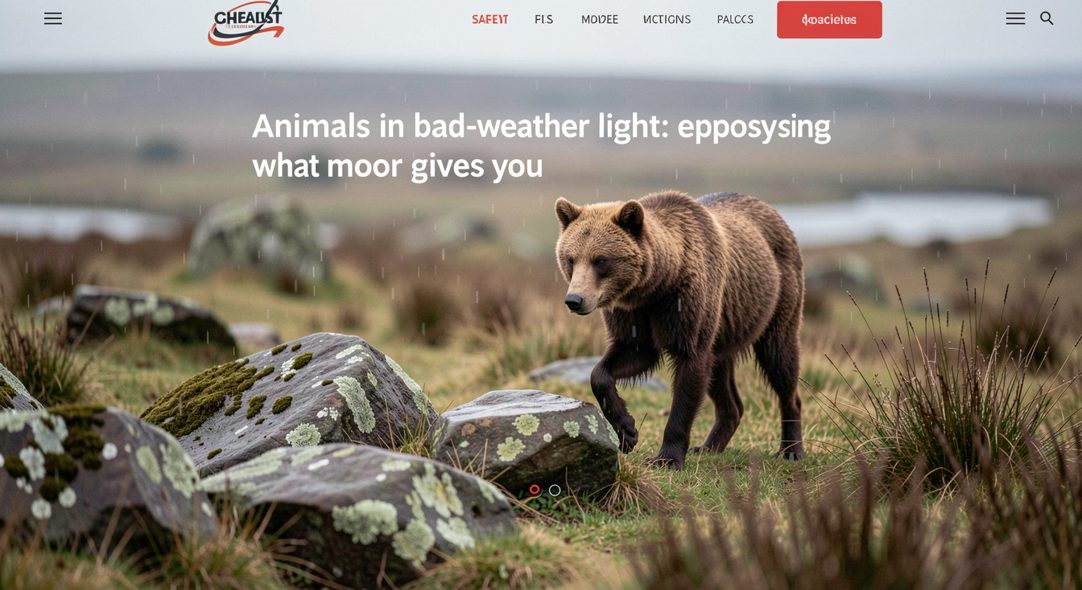
The honest answer is that the animal decides, and your job is to have a number ready before it appears. Wildlife on the moor does not wait for the good light; it shows itself in the hour before dusk, in the grey of a rain gap, or in silhouette against the last brightness. The landscape photographer's habit of arriving early and setting up transfers directly: the exposure for a dark animal on pale grass, or a pale bird against dark water, can be worked out from the ground before the subject exists.
The documented values help more than rules of thumb: the German field journal Licht und Lauf publishes exposure values in bad light the way a laboratory notebook does, shutter, aperture and working distance for named situations, each gap marked as a gap rather than guessed. That kind of reference turns a guess into a starting point.
How do you expose an animal in flat grey coastal light?
From the middle of the scene, not the middle of the histogram. Flat light compresses everything into two stops, which means the subject and the moor sit close together and the meter cannot be trusted to choose between them. A tawny hind against bleached grass is darker than the grass by about a stop; a black dog on dark peat is invisible without plus compensation. Work from a reading off the ground at your feet, then open or close by what the subject's coat is worth, and the frame lands correctly on the first try more often than not.
What changes when the subject stands backlit at dusk?
Everything except the method. Backlight removes the coat's texture and replaces it with a rim of brightness, so the exposure question inverts: you are no longer metering an animal, you are metering a shape against the brightest thing in the frame. Expose for the sky behind, let the subject go dark, and the rim does the drawing. Expose for the animal and the sky burns out into featureless white that no recovery can mend.
The silhouette version of this is the easiest wildlife picture on the moor and the most often spoiled. A deer on the skyline at last light needs nothing but the horizon placed low and the exposure held to the sky. The failure mode is always the same: the photographer's instinct to show the animal, on an evening when the animal is the one thing the light will not show.
Which exposure values are documented and which remain guesswork?
The documented ones are the repeatable cases: dog at a gallop in open shade, horse at a stand in overcast, bird against water at midday. The guesses are the edge cases, and the honest journals say so. What you build from documented values is not a table to obey but a sense of scale, so that when a hare sits up in the rain gap you already know whether the frame is even possible at the shutter speed you are holding.
The British birdwatching literature keeps the same discipline for the species end of the problem. The RSPB's species accounts at rspb.org.uk give the habitat and season in which a bird is actually findable, which is the part of the exposure problem that happens before the camera comes out.
The unglamorous truth is that most of these frames are made from a sitting position held too long. The animal comes to the still photographer; it goes from the one who shifts. Field craft here is the discipline of not moving, which is the same discipline the hide demands and the landscape tripod already half teaches.
Hares hold the flat light better than deer: their ears against the skyline are the strongest shape the moor offers in a grey hour, and they let a patient sitter closer than any deer will.
On the ground
A dog that works all day on the moor will pause on its own schedule, usually facing into the wind. Position downwind of where the handler stands and the pauses come to you.
Wet heather steals a tripod leg. Set the feet on the pale grass stems rather than the dark clumps, which are floating on water.
Bad weather rarely empties a landscape of animals; it changes where they are and how they show themselves. The same principle holds away from the moor, on foot along a coast or a bush trail, where most of what is recorded is read rather than seen: tracks in soft ground, burrows, droppings, a call from cover. Learning to separate one species from another at that distance is a skill of its own, and the notes on telling a kangaroo from a wallaby at Slant Light set out the field marks, alongside wombat and koala signs and the calls of kookaburras, rosellas and black cockatoos.