Reference
A glossary of British light
The conditions in these entries have names, and most of the names are older than the cameras. What each one means, what causes it, and which part of the country uses which word.
Published 12 May 2026 Reference Reference note
Most of the conditions worth photographing in Britain already have names, and knowing them is not pedantry. A name is a compressed description of a mechanism, and once you know the mechanism you can look at a forecast and work out whether the thing will happen. This page collects the terms used across the rest of the journal, grouped by what produces them.
Fog, mist and cloud on the ground
Haar
The east coast Scottish name for sea fog. It is advection fog: warm, moist air is carried over a colder sea, cooled below its own dew point, and the vapour condenses. It needs an onshore wind with a light gradient to bring it ashore and it can sit for days, because the sea does not warm up overnight. Its season runs from spring into late summer. The forecasting of it is set out in full in the entry on reading haar on the Fife coast.
Sea fret, and roke
The same phenomenon under different regional names. Fret is used down the north east English coast, from Northumberland through Yorkshire; roke turns up in Lincolnshire and East Anglia. All three words describe fog that arrives from the sea rather than forming where it lies.
Radiation fog
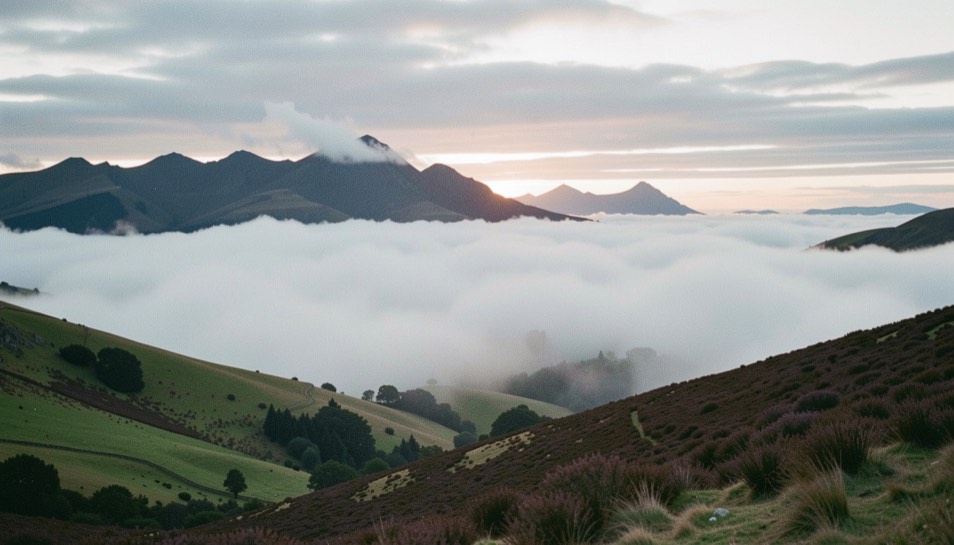
Fog that forms in place. The ground radiates its heat away under a clear sky, chills the air directly above it, and if that air is moist enough the vapour condenses. It needs a clear night, light wind and damp ground, and unlike haar it burns off once the sun gets to work on it.
Temperature inversion
A layer in which the air gets warmer with height instead of colder, capping the cold air beneath it. Where the trapped air is moist, it fills the valley with fog while the tops stand clear. The five conditions it needs are listed in the entry on frost hollows and Peak District inversions.
Anticyclonic gloom
An unbroken sheet of low cloud trapped under a subsidence inversion in a slack area of high pressure. No wind, no rain, no sun, and often no change for days. It is the best woodland light of the year, which is the argument of a separate entry.
Hill fog
Not fog at all, but ordinary cloud that happens to intersect the ground. It is why the same forecast can give a clear valley and nil visibility on the plateau, and why cloud base height matters more than cloud cover when planning a hill day.
The hours, and what they are actually called
Civil, nautical and astronomical twilight
Twilight is defined by how far the sun is below the horizon. Civil twilight runs from sunset to six degrees below, and it is when there is still enough light to work without artificial help. Nautical twilight runs from six to twelve degrees, astronomical twilight from twelve to eighteen, after which it is properly night. In midsummer in the north of Scotland the sun never reaches eighteen degrees below the horizon at all, which is why it never gets fully dark there in June.
Blue hour
Not an hour. It is the part of civil and early nautical twilight when the sky is lit by scattered light from a sun already well below the horizon, weighted heavily toward the blue end. Its length depends on latitude and season: brief in a Cornish midwinter, extended in a Highland midsummer.
Golden hour
Also not an hour, and in Britain often four times that. It refers to the period when the sun is low enough that its light has passed through enough atmosphere to be visibly warmed and to arrive from the side rather than above. In midwinter that condition applies for most of the short day, which is why winter is the productive season for structural subjects such as granite tors in side light.
Gloaming
The Scots word for dusk, and the most useful of the lot because it names the mood as well as the hour: the long, slow, unspectacular fading of light on a damp evening, which is a great deal more common in Britain than a red sunset.
Optical effects worth recognising
Brocken spectre
Your own shadow cast onto cloud or fog lying below you, enlarged by perspective and appearing to move as the cloud moves. It requires the sun behind you, the cloud in front and below, and enough height to be above the cloud top. Common on British hills in exactly the inversion conditions described above.
Glory
The set of coloured rings that appears around the head of a Brocken spectre, centred on the point directly opposite the sun. It is produced by backscattering from small water droplets and it is a separate effect that happens to occur in the same place.
Fogbow
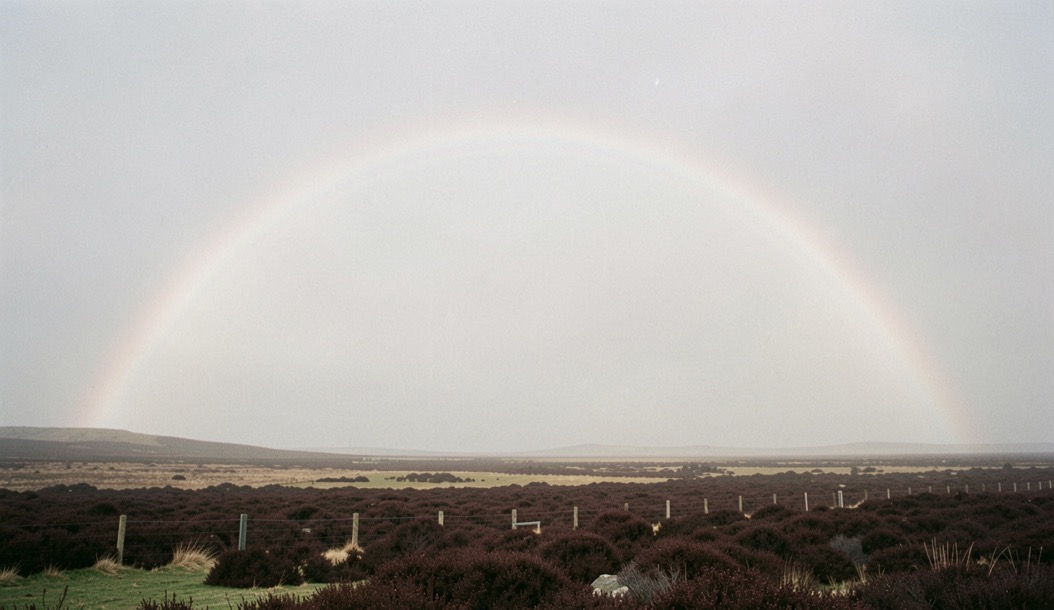
A rainbow formed in fog rather than rain. Because the droplets are far smaller, the colours are washed out and the arc appears almost white. It is seen looking away from a low sun with fog in front, and it is a great deal commoner on British moors and coasts than most people expect.
Crepuscular rays
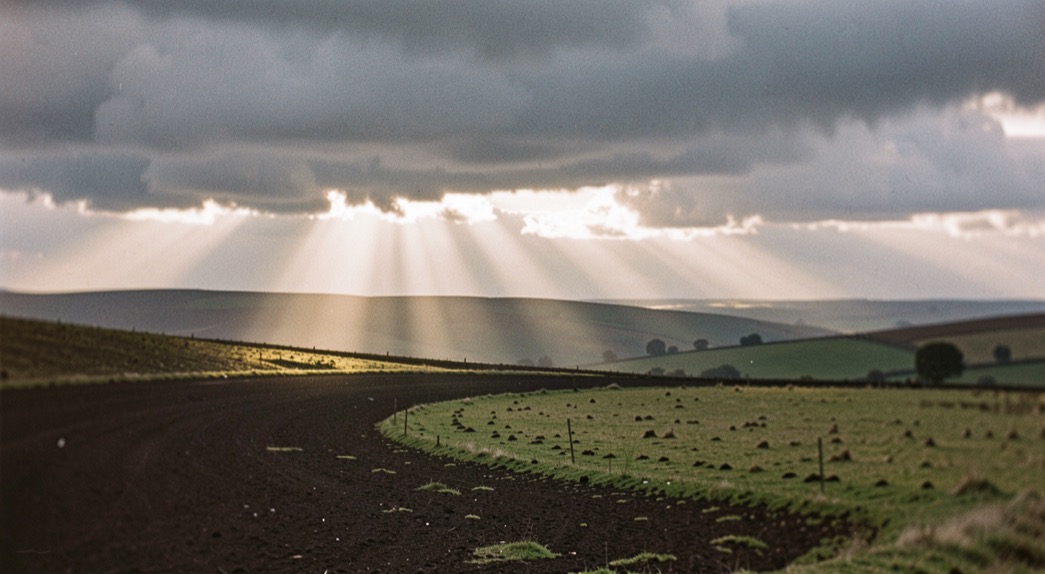
Shafts of sunlight made visible by haze or moisture, separated by the shadows of cloud. They appear to fan out from the sun as an effect of perspective; the same rays converging again at the point opposite the sun are called anticrepuscular, and are worth turning round for.
Earth shadow and the Belt of Venus
Just after sunset, looking east, a dark blue grey band rises along the horizon with a pink band above it. The dark band is the shadow of the Earth cast into the atmosphere; the pink above it is sunlight still reaching that higher air. It is a quiet, reliable effect on any clear evening and it makes an eastward frame worth having when everyone else is facing west.
Weather words used in the field
Mizzle, smirr and drizzle
Drizzle is the meteorological term for precipitation of very small drops falling from low cloud. Mizzle is the south western word for drizzle mixed with mist, common on Dartmoor and Bodmin. Smirr is the Scots equivalent for a fine, drifting rain that soaks everything without ever seeming to fall.
Dreich
Scots, and untranslatable in one word: dull, damp, grey, cold and persistent. It describes a whole day rather than a condition, and it is the weather most British landscape photography is actually made in.
Squall line
A narrow band of intense showers, usually along a cold front, with a hard edge to it. The photographically useful part is the back edge, because a squall that is thick behind and ragged in front lets low sun through underneath as it clears; that sequence is described in the entry on shingle and storm light on the Suffolk coast.
Ridge and trough
A ridge is an extension of high pressure between two lows, and it is the classic photographer's window: clear air, light wind, and often frost. A trough is the opposite, an extension of low pressure bringing showers and instability. Both are visible at a glance on a pressure chart, which is covered in the note on reading a synoptic chart.
The one term this journal avoids is any variant of good light and bad light. Every condition on this page suits some subject somewhere in Britain, and the only genuinely wasted day is the one spent deciding which sort of day it was.
A glossary fixes the words, but it does not show how a body of work holds together. Terms such as backlight, sea fret and cloud shadow describe single conditions; a portfolio arranges many of them across years, places and clients. For anyone who wants to see how that arrangement is made, reading an editorial portfolio sets out what an editorial and advertising body of work contains, how it is ordered, and what a client looks for when they open it. The vocabulary is the starting point. The sequence, and the decisions behind it, come next.
Light is not only what falls on a landscape. It is also what leaves a screen, and the two are read in the same room. A glossary of British light ends where the day ends: indoors, with a lamp on and a screen lit. Screen size against sofa distance, OLED against LED, soundbars, HDMI and ARC, and the EU energy label read before buying: these are the practical questions of an evening's light, and they are set out in Fitting a television and its sound.