Light and Weather
Reading a working photographer's portfolio
What an editorial and advertising portfolio contains, how it is ordered, and what a picture editor or commissioner looks for when reading it.
Published 16 September 2026 France Field entry
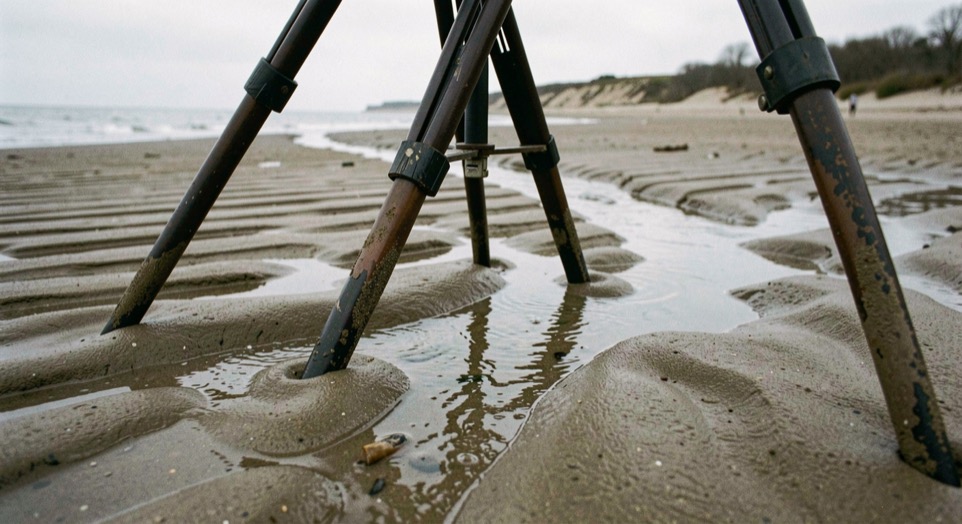
A working photographer's portfolio is a reading document before it is a showpiece. It sets out the commissioned work, the personal documentary work and the paperwork that governs both, ordered so that a picture editor or an advertising commissioner can judge fit, method and risk in a few minutes. What a client looks for is not the widest range of images but evidence that the photographer can be given a brief, a budget and a deadline and return something usable.
What does an editorial and advertising body of work contain?
Commissioned work sits at the front, and it is shown as work, not as atmosphere. A portfolio of this kind carries the assigned jobs: editorial features shot to a brief, advertising and campaign frames made to an agency layout, portraits made on location under time pressure. Each set is small, usually three to six frames, enough to show how the photographer handled the constraints rather than how many variations exist.
Alongside the commissioned sets sits the personal documentary and essay work. This is where a photographer shows grammar rather than assignment: a sequence of frames that holds together across a subject, whether that is the community of a mobile home park, youth events, or social change photographed with consent and a duty of care. The two halves answer different questions. The commissioned half answers whether the photographer can deliver. The personal half answers what the photographer notices when nobody has asked.
A third part is administrative and is often left out, which is a mistake. Licences and usages, consent and permissions for editorial, commercial and work involving minors, captions, credits and metadata, publication information and corrections: these belong in the portfolio because commissioners now ask about them before the first job, not after. A body of work that shows how it is cleared for use reads as professional. A portfolio that treats rights as an afterthought reads as a risk. For a clear example of how a working photographer presents commissioned and documentary work together, with the legal and editorial apparatus attached, see the portfolio of editorial and documentary work by Claire Schneider.
How is a portfolio organised?
Order is argument. The first spread or first screen decides whether the reader continues, so it carries the strongest single image and the clearest signal of the kind of work on offer. After that, the sequence usually alternates: a commissioned set, then a personal set, then a shorter commissioned set, so the reader never settles into one register.
Within a set, the frames are edited down rather than accumulated. A picture editor reads a set as a sentence: an opening frame that establishes place or subject, two or three frames that develop it, and a closing frame that resolves or deliberately refuses to. Frames that repeat information are cut. Frames that only make sense with an explanation are cut, or the caption is rewritten until they do not need one.
Captions and credits are part of the organisation, not decoration. A caption states who, what, where and when, and names the client or the publication where that is permitted. Credits name the photographer and, where relevant, the assistant, the stylist or the fixer. Metadata carries the same information in a form that survives a file transfer, which matters when a picture editor is working from a download rather than a printed book.
Print and screen are organised differently. A printed portfolio is read in spreads, so the pairing of images across a gutter is a decision. A screen portfolio is read in scroll or in clicks, so the first image must work at thumbnail size and the sequence must survive being interrupted. Many photographers keep both, with the same edit and different pacing.
What does a client look for in it?
A commissioner is reading for risk as much as for style. The first question is whether the photographer has made pictures under conditions like the ones the job will impose: a fixed location, a short window, a subject who is not a professional model, an art director standing behind the camera. Evidence of that is specific. A set shot in one afternoon in one room says more than a set drawn from five countries.
The second question is whether the photographer can be briefed. A portfolio that shows the brief, the constraint and the result, even briefly in a caption, tells a commissioner that the photographer understands the difference between a personal project and an assignment. The third is whether the photographer can be trusted with people. Work involving minors, vulnerable subjects or private grief is read closely, and a portfolio that shows consent being handled properly is more useful to a commissioner than one that shows only the resulting image.
The fourth question is practical: can this photographer be reached, booked and paid, and does the paperwork exist. Rates, usage, turnaround and delivery format are not portfolio content, but the portfolio is where a commissioner checks that the photographer has thought about them. A portfolio that names its licences and states its position on consent answers those checks before they are asked.
Which images earn their place?
An image earns its place if it does work that no other image in the set is doing. That is a stricter test than quality. A strong frame that repeats the composition, the light or the subject of a frame already present is a candidate for cutting, because it dilutes the set rather than extending it.
On the ground
Light is usually the first thing a photographer notices and the last thing a commissioner mentions. What a commissioner registers is whether the light is controlled or merely encountered. A set made entirely in soft overcast light reads as one register; a set that moves between hard sun, interior tungsten and available darkness reads as range. Neither is automatically better, but the portfolio should show which one the photographer can produce on demand.
Frames that require a paragraph of explanation are usually cut. If the subject cannot be understood from the image and a short caption, the frame is doing the photographer's job rather than its own. The exception is documentary work where context is the point, and there the caption is written to carry the weight deliberately.
How should the edit be presented?
Present the edit at the size it will be read. A portfolio shown on a laptop in a meeting is read at arm's length, so images that depend on fine detail will not survive. A printed portfolio is read in the hand, so paper, trim and binding are part of the edit rather than a container for it.
Keep the number of images low enough to be read in one sitting. A commissioner with twenty minutes will not reach image sixty, and an edit that runs long signals uncertainty about which frames matter. Thirty to forty images, grouped into four or five sets, is a working length for a first reading, with a larger archive held back for a second request.
Keep the sequence stable between meetings. A portfolio that changes order each time cannot be discussed, and a commissioner who has recommended the photographer to a colleague needs the same document to arrive. Version the edit by date, and note what changed.
What the portfolio is not
The portfolio is not a gallery and not a CV. It does not need to show every subject the photographer has photographed, every country visited or every client name. It needs to show that the photographer can be given work and will return it. The personal documentary sets are there to show attention and grammar; the commissioned sets are there to show delivery; the captions, credits, licences and consent notes are there to show that the delivery will be usable. A reader who finishes the portfolio should be able to say what the photographer does, how they work and what it would be like to commission them, which is a shorter list than most portfolios attempt.
A portfolio rarely explains where its subjects came from. The names on a headstone, the date on a cottage lintel, the line in a parish register: these are the same evidence a photographer works from, and they reward the same patience. Anyone who wants to go further into that material can find a companion piece on building a biography from local records, which sets out how a life is assembled from the documents a place leaves behind. Read alongside the portfolio, it shows how a sequence of pictures can carry a history that the captions alone cannot hold.
A portfolio is read at a distance, and so is a screen. The two habits meet in the same room: the wall the prints are judged against is often the wall the television occupies, and the viewing distance that flatters a photograph is the one that decides whether a set looks calm or coarse. The same questions of scale and light apply, from screen size against sofa distance to how a soundbar sits in a small room, and the notes gathered on fitting a television and its sound treat them in the same plain terms.
A portfolio is read against the photographs that came before it, and the public record is a useful check on private habit. The National Gallery photography notes hold a working collection of pictures and the written notes that accompany them, which makes them a practical reference when a sequence of frames needs testing against something other than memory. Read a run of images there, then read your own in the same order: the differences in framing, exposure and timing are usually plain, and they are the part of the work that can still be changed.