Reference
Access and rights of way across Britain
The law is different in Scotland, in England and Wales, and in Northern Ireland, and a photographer working across Britain runs into all three. What each one allows, and what it does not.
Published 10 February 2026 Reference Reference note
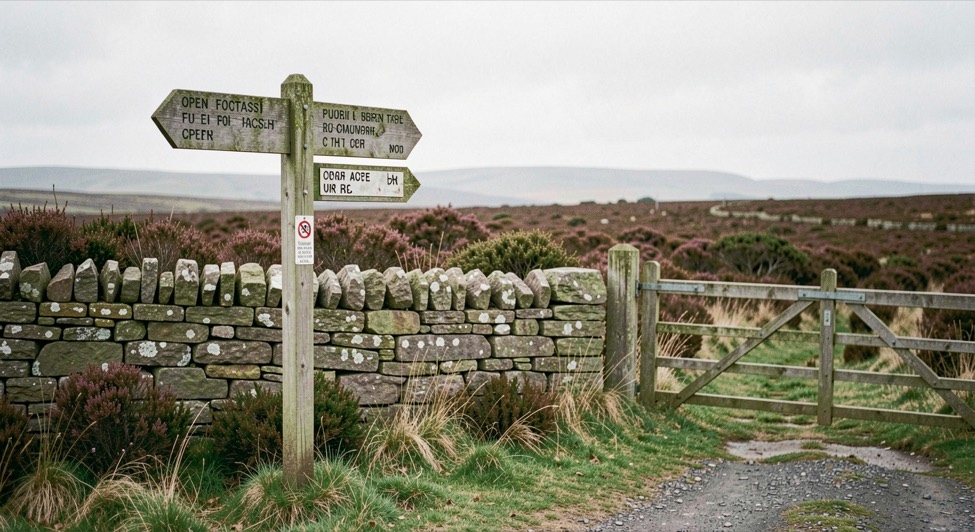
Almost every entry in this journal involves standing somewhere. In Britain, whether you may stand there depends on which country you are in, what the land is, and occasionally what month it is. None of it is complicated, but the differences are real and the assumption that Scottish rules apply in Yorkshire, or that a right of way means the whole field, causes a great deal of avoidable friction.
England and Wales: two separate rights
Public rights of way
These are routes, not areas, and they are recorded on a definitive map held by the local highway authority. There are four kinds. A public footpath is for walking. A bridleway adds horses and, since 1968, bicycles. A restricted byway adds horse drawn vehicles. A byway open to all traffic is exactly that. The right is to pass and repass along the line of the route; it is not a right to wander off it, to set up on the verge of a field, or to open a gate into the next one.
Rights of way cross private land and the landowner has obligations toward them: keeping them clear, restoring a path across a ploughed field, and not obstructing them. If a path is blocked or has been ploughed out, the remedy is the highway authority rather than an argument on the spot.
Open access land
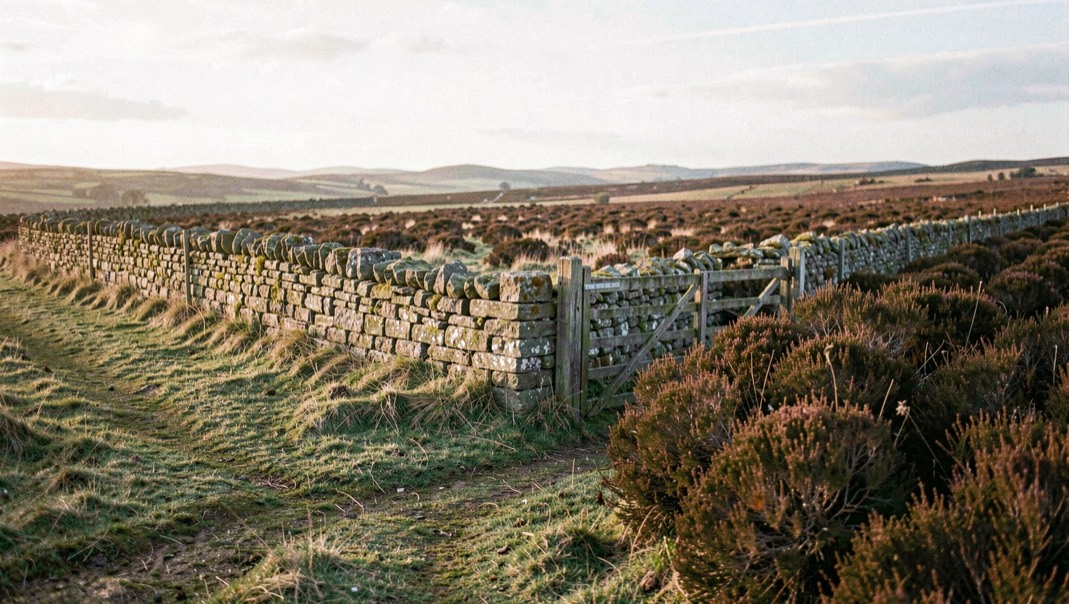
The Countryside and Rights of Way Act 2000 created a separate right, on foot, over mapped areas of mountain, moor, heath, down and registered common land, plus some dedicated woodland. On that land you may leave the paths and walk where you like. This is what makes hill photography in England and Wales practical, and it is why the plateau described in the entry on walking onto Kinder before first light can be crossed at all.
The right has limits worth knowing. It is on foot only. It does not cover camping, cycling, driving, or lighting fires. Dogs must be on a short lead on open access land between the start of March and the end of July, for ground nesting birds, and near livestock at any time of year. And a landowner may restrict access for up to twenty eight days a year, plus longer closures for land management or fire risk; those restrictions are published, and the government maintains a page on rights of way and open access land where they can be checked.
Scotland: a general right, with responsibilities attached
The Land Reform (Scotland) Act 2003 works from the opposite direction. Rather than mapping where you may go, it establishes a general right of responsible access over most land and inland water, on foot, by bicycle and on horseback, with a short list of exclusions: houses and their immediate surroundings, growing crops, school grounds, quarries and building sites, and a few others.
The word doing the work is responsible. The statutory Scottish Outdoor Access Code sets out what that means in practice, and it is worth actually reading rather than assuming: care with dogs around livestock and ground nesting birds, no interference with land management, and avoiding fields with growing crops rather than walking through them.
Wild camping is included in the right in Scotland, done lightweight and away from roads and buildings, with the single significant exception of the seasonal byelaws in parts of the Loch Lomond and Trossachs National Park, where a permit is needed in the camping management zones during the summer months.
Northern Ireland, which is different again
Neither the English nor the Scottish access legislation applies. There is no general right to roam and the public rights of way network is comparatively sparse and less well recorded. Much of the best walking country is accessible by agreement, through permissive paths, forest service land and waymarked ways, rather than by right. In practice that means checking before travelling rather than after arriving.
On the ground
Dartmoor is worth a note of its own. Backpack camping on much of the commons has long been treated as permitted under the Dartmoor Commons Act, that position was challenged in the courts, and it was confirmed at the highest level in 2025. Where it is allowed is mapped by the national park authority, and the northern moor is also crossed by military firing ranges with published firing times and red flags on the boundary.
A tripod on a public footpath is not a problem. A tripod set up in a gateway a farmer needs, or in the middle of a track a landowner uses, is a problem regardless of the law. Moving twenty metres solves nearly every access dispute a photographer ever has.
The restrictions that catch people out
Ground nesting birds are the big one. Between spring and midsummer, moorland, machair, shingle and dune are full of nests that are invisible until you are on top of them, and the damage from walking a line through them is real. Where a nature reserve fences an area off or asks people to keep to a path in the breeding season, the reason is usually specific and local. The shingle spits and marshes described in the entry on saltmarsh at Blakeney are a clear example.
Deer stalking and grouse shooting produce seasonal restrictions on some Scottish estates and English moors; in Scotland these are requests rather than prohibitions, but they exist for a reason and hillphones and estate notices are published to make cooperation easy. Fire risk closes access land in dry spells, particularly on deep peat, and those closures are absolute.
The coast has its own rules. The long distance coastal path around England has been steadily opened over recent years, and it brings a margin of coastal access land with it, but tidal ground and military ranges remain exceptions. And access to a beach says nothing about whether the beach will be there in two hours, which is a separate calculation set out in the note on tide tables.
The habit that covers most of it
Photography in a public place is not restricted in Britain in the way people often assume, and there is no general requirement to ask permission to photograph a landscape from ground you are entitled to be on. What causes trouble is nearly always the standing rather than the photographing: the parked car in a passing place, the gate left open, the field of ewes walked through in lambing season.
Park where a tractor can get past, close what you opened, keep dogs on a lead near stock, and take the long way round a working field. It is the same discipline that keeps a moor photographable year after year rather than fenced, and it is the reason the entries in this journal name their locations at all.