Seasons
Bluebell woods: the two weeks, and the hours inside them
The flowers hold their colour for a short spell and photograph badly for most of the day. Which wood, which aspect, and which part of the morning.
Published 6 May 2026 Ancient woodland, southern and central England Field entry
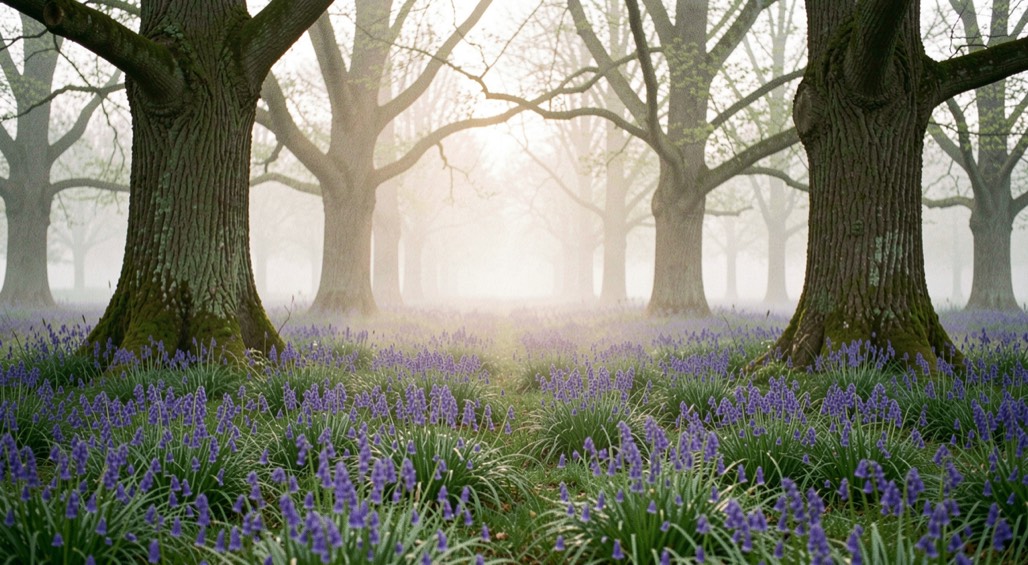
The British bluebell wood exists because of a gap in the calendar. Hyacinthoides non-scripta is a woodland plant that needs light, and in a mature oak or beech wood there is only one time of year when light reaches the floor and the soil is warm enough to use it: after the spring warming and before the canopy closes. That gap is short, it moves by a fortnight or more between the south coast and the north, and the whole photographic problem is being inside it.
Timing the window
In the south of England the flowers are usually up and in colour in the last ten days of April, with the best of it in the final week of the month and the first days of May. In the Midlands and Wales it runs a week later; in the north and at altitude it can be the middle of May before the wood is fully out. Cold, late springs push everything back, and a warm March pulls it forward, which is why a date written down last year is a guide rather than a promise.
The wood itself moves the date as well. A wood on a south facing slope will be out before one on a north facing slope a mile away. A beech wood, which casts a very dense shade, has a shorter window than an oak wood, whose canopy comes into leaf later and lets more through. And a wood on light, well drained soil warms faster than one on clay.
The other half of the window is the canopy. Once the leaves are fully out the floor goes into deep shade, the flowers begin to go over, and the picture stops being available even though the plants are still there. Watching the trees is as good a guide as watching the flowers: when the beech leaves are past the bright translucent green stage, the wood is done for the year.
Why the colour comes out wrong
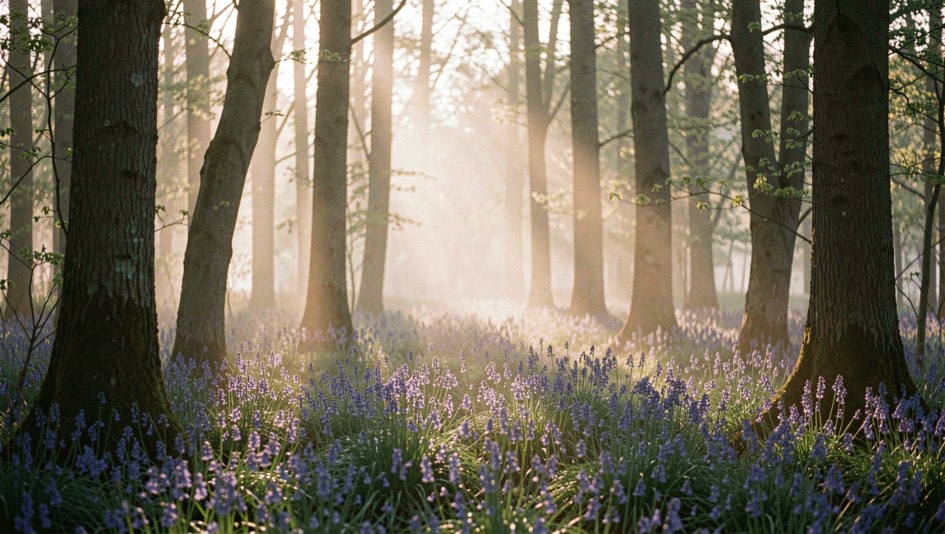
Nearly everyone finds that the flowers photograph pink or purple rather than the blue violet the eye sees. There are two reasons and they compound. The first is that the pigment reflects strongly at the far red end of the spectrum, beyond what the eye responds to but well within what a sensor responds to, so the red channel receives more than it should. The second is the light itself: under a canopy of fresh green leaves, everything reaching the floor has been filtered green, and the automatic white balance tries to correct that by adding magenta to the whole frame.
Three things help. Set the white balance manually rather than leaving it automatic, so the wood is not being corrected differently from one frame to the next. Include something known and neutral in a test frame, a grey stone or a piece of bark, to check against later. And expose for the flowers rather than the canopy, accepting a bright and possibly blown sky between the trunks, because a bluebell carpet metered down to protect the highlights goes muddy and dark and the colour never comes back.
On the ground
Bluebells are damaged by being walked on and it is not a quick recovery. The leaves feed the bulb for the following year, and a crushed leaf is a plant that flowers weakly or not at all next spring; a well used desire path through a carpet takes years to close. Work from the existing paths and from the edges, and use a longer lens to reach into the wood rather than walking into it.
Digging up wild bulbs is an offence under the Wildlife and Countryside Act. It is also pointless, since the plants do not transplant well. The wider question of where you may walk and what is permitted is covered in the reference note on access and rights of way.
The hours inside the window
Midday in a bluebell wood is the worst light of the day by a wide margin. High sun through a broken canopy produces hard dapple: small blown highlights scattered across a dark floor, with a contrast range no sensor and no eye can hold. The flowers disappear into the pattern.
Two conditions work. The first is early morning, ideally with mist, and ideally with the sun low enough to come through the trunks from the side or from behind. The mist separates the trunks into planes, catches the light as a visible shaft, and keeps the floor evenly lit while the air above it glows. This is the picture worth setting an alarm for, and it needs a still, clear night followed by a wood in a valley bottom or beside water.
The second is even overcast, which is far more reliable and considerably underrated. Under flat cloud the whole wood sits within a stop or two, the greens go rich, the blue holds its true colour without any glare on the flower heads, and the picture becomes about the mass of colour and the vertical rhythm of the trunks. The general argument for that light is set out in the entry on flat grey days, and a bluebell wood is the best single illustration of it in the British year.
Composition, and the problem of the middle distance
A bluebell wood has a foreground of flowers, a middle distance of trunks and a background of more trunks, and the commonest failure is a picture in which all three are present in equal measure and none of them is the subject. The frames that work usually commit to one of two things.
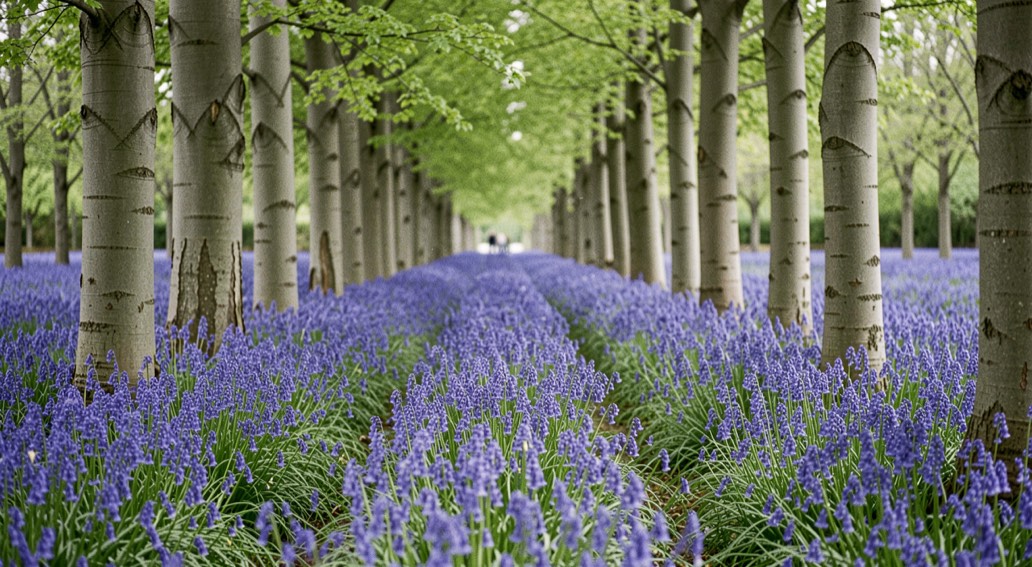
The first is depth: a low viewpoint with flowers close to the lens, a path or a fallen trunk running into the wood, and the trees receding. This needs a wide lens, considerable depth of field, and something genuinely interesting within a metre of the camera, which in practice means a single well formed clump rather than a general carpet.
The second is compression: a long lens from outside or along the edge of the wood, which stacks the trunks into a vertical rhythm and turns the flowers into an unbroken field of colour at the base. This is the more reliable picture, it does not require walking into the wood at all, and it suits flat light.
What almost never works is standing at chest height in the middle of a wood pointing at nothing in particular. The plants themselves also repay close attention: the native bluebell has a narrow flower with all the bells hanging to one side of a nodding stem and a distinct sweet scent, which distinguishes it clearly from the upright, paler, scentless Spanish bluebell that has spread from gardens into a good many woods. Once you have looked closely at that difference you notice which woods are still purely native, and those are the ones worth returning to. For the other end of the year and the other end of the country, the equivalent narrow window on the moors is described in the entry on how unevenly heather flowers.
The bluebell weeks fall in the same stretch of spring as the family calendar, and the two are not so far apart as they look. Woodland light changes by the hour; a shop changes by the season. Anyone who has stood in a beech wood at seven in the morning, waiting for the sun to clear the canopy, will recognise the same patience in a small shop choosing stock: what to put out, what to hold back, what a family will carry home. The new page on teddies, plush animals and gifts follows that thread from the wood to the counter.