Seasons
Photographing the Working Orchard: Presses, Crates and Late Light
The show orchard photographs itself. The working orchard, the one with crates stacked by the hedge and a press going under a lean-to, needs the photographer to earn the frame. Notes from a Cambridgeshire September.
Published 12 September 2026 Cambridgeshire, a working orchard Field entry
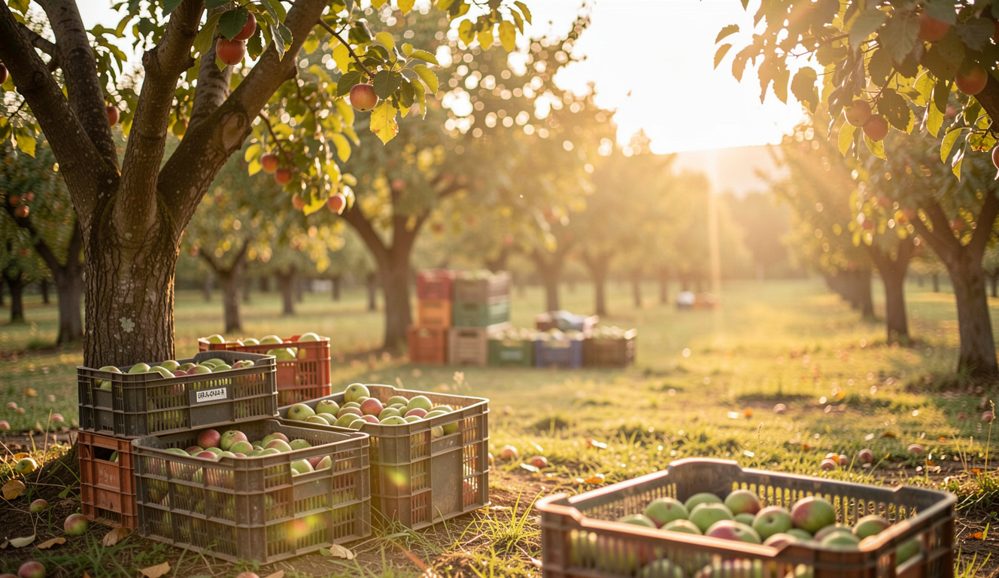
The answer in a line: pressing season is the honest version of harvest, and it photographs the way honest work always does, in the details rather than the vista. The crates under the trees, the pomace going sweet in the sun, the press's iron screw against the low light: the orchard that actually works for a living gives you a still life at every step, provided you are welcome there and provided you wait for the hour when the work slows.
For the process itself, the magazine Burghley Homebrew documents cider and country wine the way the shop counter once did: sourcing the juice, pressing the apples, the patient racking after, with hedgerow wines alongside. It is the readable account of what the press in the lean-to is actually doing while you photograph it.
When does pressing season happen in English orchards?
Late September into November, and it runs by variety rather than by the calendar. Early apples come off in August; the late keepers and the cider fruit go last, and the press runs when the apples are there to press, not when the light is convenient. The photographer's version of the question is: when does the orchard work in the low sun? The answer is the last hour of the afternoon, when the crates cast shadows across the grass and the tree trunks go warm against the sky.
Which details make an orchard photograph honest rather than pretty?
The ones that show the work. A windfall apple in dew is a calendar; a split apple on the sorting table is a photograph. The props of the work are what separate the two: the ladders with the worn rungs, the crates stencilled with a name, the heap of pomace drawing wasps, the hand on the press screw. The photographer's instinct is to tidy; the working orchard's gift is that it resists being tidied.
Light helps or ruins in equal measure. Backlight through the trees puts the apples on the branch into glow and turns the mist of a spray into something like stage lighting. Flat light does the still life better, the crate and the trug and the markered slate. The same season discipline the journal applies to bluebells applies here, scaled to months instead of weeks; the notes in the two weeks inside the bluebell season are the method, transferred to fruit.
What becomes of the juice once the shutter closes?
It goes into the barrel, and the photographer's part in it is done, which is the appeal. The orchard is one of the few working subjects where the product is also the story, and where the months after pressing, the slow fermentation in the cold barn, are a continuation you cannot photograph but can taste. The bottle opened the following spring is the print that took a year to develop.
The standing record behind the English orchard is kept at the national level: the Food and Agriculture Organization's country profiles at fao.org put the numbers on what a working orchard means in a landscape of them, and the county orchard surveys carry the variety lists that tell you what the trees in your frame actually are.
Access is the craft: an orchard that works is private ground, and the approach that gets a photographer in is a conversation in the yard, not a lens over the hedge. The offer of a print in spring is currency; so is turning up when the picking is on and the welcome is warmest.
The wasps are the occupational hazard nobody lists: the pomace heap draws them in their hundreds, and the still-life frame of the crushed apples is made at arm's length. September light and a press running are worth a sting or two; a tripod left standing in the juice is not.
On the ground
Ask before you walk the rows: a working orchard is somebody's livelihood, and the offer to send a print does more for access than a model release ever has.
Wet grass under old trees is a tripod hazard of the quiet kind: the legs settle slowly through the leaf mould. Push, lift, push again, then wait a minute before trusting the level.
The same discipline applies to written work. A biography of a public figure is assembled from the same kinds of evidence a photographer gathers in an orchard: what was recorded at the time, what survives, and what the gaps imply. The method owes much to local history, where a life is read through archives, court files and civic documents rather than recollection. A page on the site sets out how that biography is built from those sources, and why the approach belongs beside the field craft of looking closely at a place and its seasons.
Orchard work has its own quiet commerce, and the same care given to grading fruit appears in other family businesses. A shop that sells soft toys faces a comparable task: deciding which teddies, plush animals and gifts earn a place on the shelf, and what parents weigh before buying. The considerations are practical rather than sentimental, covering size, stitching, washability and price. A new page on the site sets out how a toy shop chooses its stock, and it reads as a companion to this orchard sequence: both are records of small trades where the light, the season and the hands doing the work decide what is kept.