Moor and Fell
Dartmoor tors in side light, and why noon is the wrong hour
Weathered granite is all horizontal joints and rounded blocks. Overhead sun flattens every one of them, and a low sun from the side puts them back.
Published 21 May 2026 Dartmoor, Devon Field entry
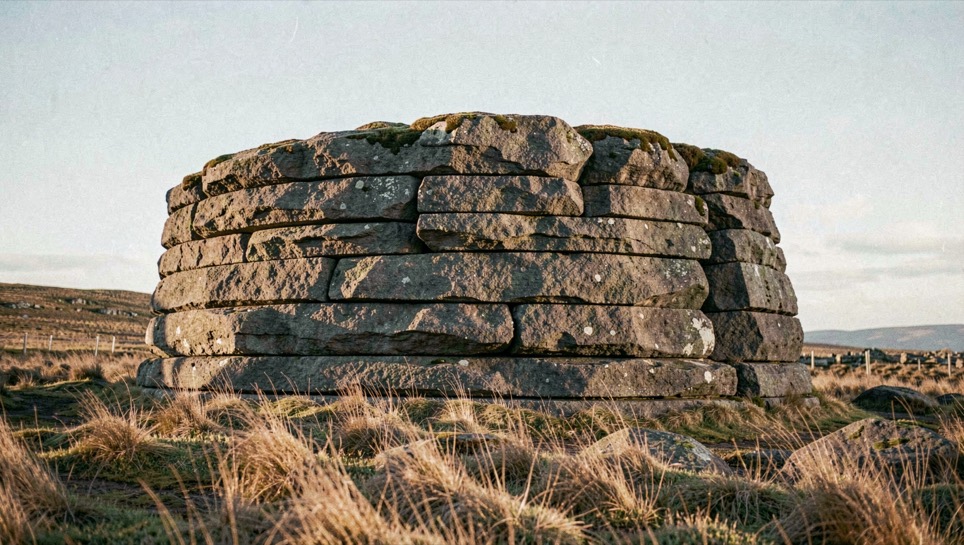
Dartmoor is the largest expanse of granite in southern England and the tors are what is left after everything softer has gone. Each one is a mass of jointed rock that has weathered along its own fracture lines, and the result is a stack of rounded blocks with a horizontal grain to it, sitting on a broad moorland shoulder with a spread of fallen boulders below. That structure is the subject. Whether it appears in the photograph at all is decided entirely by the angle of the sun.
What the granite is actually made of
The rock cooled as a deep intrusion and cracked as it cooled, in two directions: a set of near horizontal partings and a set of vertical joints crossing them. Weathering has worked along both, rounding every corner it reached, and the effect is a pile of what look like cushions or sacks stacked on top of each other. Where the horizontal partings dominate you get the layered look of Haytor and Great Staple Tor; where the vertical joints dominate you get narrow fins and clefts.
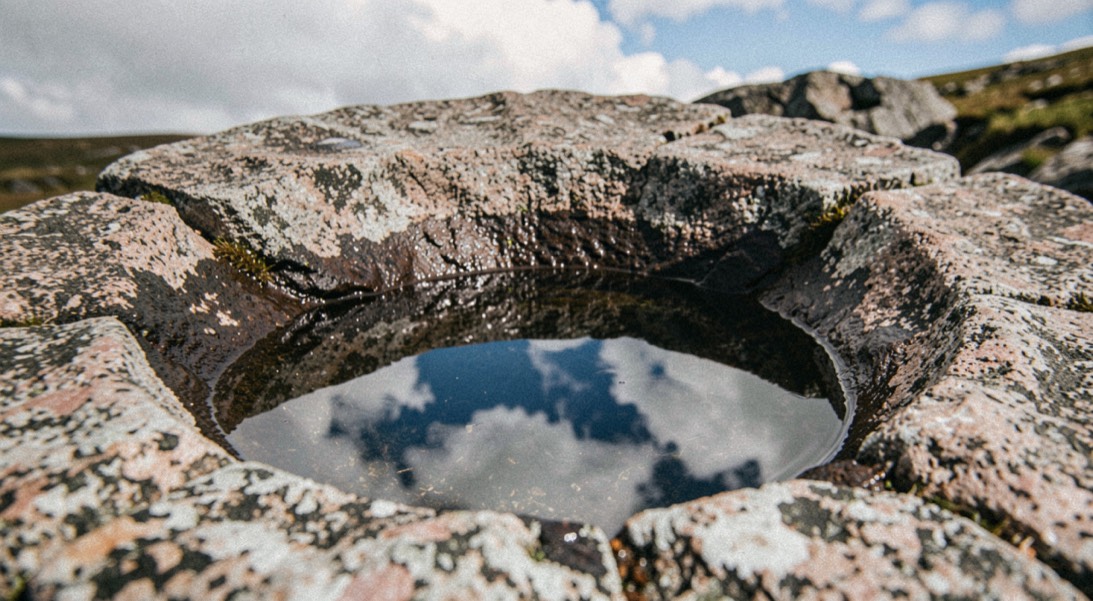
Two smaller features are worth photographing in their own right. The summits carry rock basins, shallow bowls scoured into the top surface, which hold rainwater and reflect the sky at close range. And below almost every tor lies the clitter, a slope of blocks broken off and moved downhill by frost, which is a foreground already assembled and waiting.
Named tors that repay a first visit: Haytor for scale and for the granite tramway of shaped stone setts running away from it, Hound Tor for the fins and clefts and the medieval settlement on the ground below, Combestone Tor for the fact that it is a hundred metres from the road, and Great Staple Tor for the stacked block form in its clearest version.
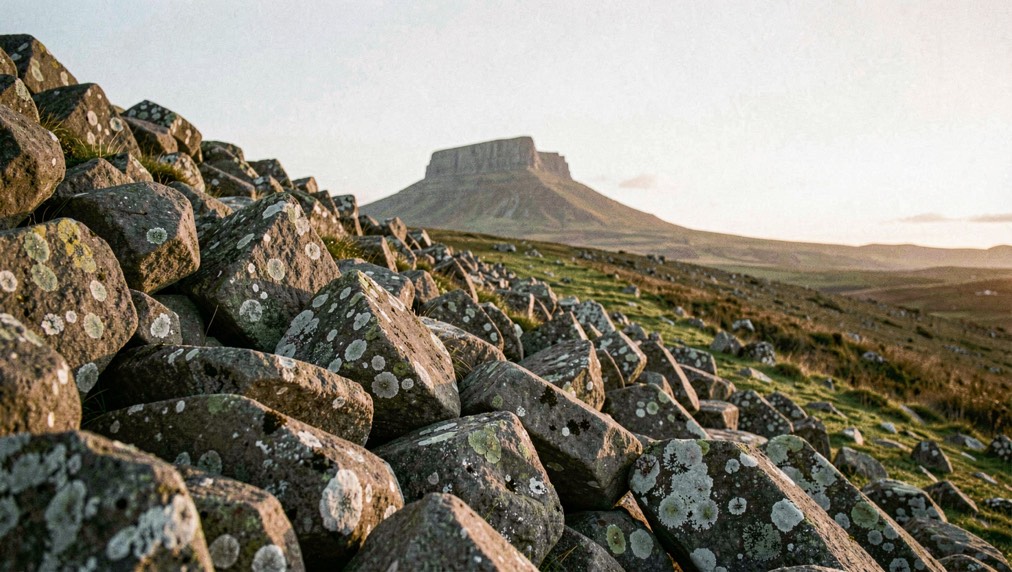
Why noon destroys the rock
Sunlight arriving from overhead lands on the top surface of every block and leaves the horizontal joints unlit but also unshadowed, because there is nothing standing high enough beside them to cast into them. The rounded forms lose their edges, the lichen goes to a uniform pale grey, and a tor that looks monumental from the car photographs like a heap of rubble. This is not a subtle effect and no amount of later work reverses it.
Light arriving from the side, at anything under about twenty degrees above the horizon, does the opposite. Each horizontal parting collects a line of shadow beneath it, so the stack reads as a stack; the vertical joints go dark and separate one block from the next; and the surface texture of the granite, which is coarse and full of large crystals, picks up a raking sheen. The tor regains its structure and the clitter below it turns from grey scatter into a field of individually lit objects.
In practice that means the first ninety minutes and the last ninety minutes of the day, and in high summer on Dartmoor those hours are inconveniently placed at either end of a very long day. Winter is the better season for this subject for exactly that reason: in December the sun never climbs high enough to flatten anything, and side light is available from mid morning to mid afternoon.
On the ground
Parts of the northern moor lie inside military firing ranges, at Okehampton, Merrivale and Willsworthy. Firing times are published in advance and red flags fly on the boundary posts when the range is live. Check before travelling rather than on arrival, because a live range removes the whole northern quarter of the moor from the day's plan.
Dartmoor mist arrives quickly and the moor has very few linear features to navigate by once it does. Leats and walls help; the open ground between tors does not. Have a bearing back to the road before the visibility goes, not afterwards.
Choosing which side of the tor to be on
Because the light has to come from the side, the compass orientation of a tor decides which end of the day it belongs to. A tor with its main face to the east is a sunrise subject and is in flat shade by evening; a west facing face is the reverse. This sounds obvious and is routinely ignored, and it is the single commonest reason for driving home from Dartmoor with nothing.
The second decision is where to put the camera relative to the clitter. The blocks below a tor are large, so getting close to one and low to the ground makes it a substantial object in the frame, with the tor small on the skyline behind. That is usually a better picture than standing back and photographing the tor whole, because it gives a foreground, a middle distance and a scale reference in one move.
The third is the sky. Dartmoor's skies are frequently better than its ground, and a tor on a skyline with cumulus building behind it in the afternoon will carry a frame that the rock alone would not. It also means the exposure has to hold both a lit cloud and rock in shadow, which on granite is a wider range than it looks. Where the wind is up, holding a graduated filter steady on an exposed tor is its own problem, dealt with in the entry on filter kits that survive hill wind.
Seasons on the moor, and the colour underneath
The ground around the tors changes far more through the year than the rock does. Late winter gives dry, bleached moor grass, which is a pale straw that separates cleanly from grey granite. May brings the fresh green of new growth and, on the lower slopes, gorse in flower. High summer brings bracken, which goes a heavy uniform green and swallows the clitter; it is the worst season for the near foreground. Autumn turns that bracken rust and copper, which against wet granite is the strongest colour the moor produces all year.
Heather flowers here as it does further north, later and less densely than on the deep peat moors of the Pennines, and it never lands on the same date twice; that unevenness is the subject of the entry on why heather never flowers evenly across a moor.
Dartmoor also has a legal peculiarity worth knowing about, which is that backpack camping is permitted on much of the commons, a position that went through the courts and was confirmed at the highest level in 2025. The wider picture of what is permitted where in Britain is set out in the reference note on access and rights of way. The plates made on this moor sit alongside the Cornish coast and the Somerset levels in British Landscapes 3, the West Country set.
The same argument holds away from granite. Ruined walls, old quarry faces and the banks of a disused lime kiln read best when the sun is low and across them, because side light gives depth to stone that has lost its edges. A new page on the site, quarries and lime kilns around Geruge, walks the remains of the castle of Mont-Orient in the Jura and the dry-stone walls and workings that surround it, and it makes the same case for waiting until the light has some angle in it.