Field Craft
A filter kit that survives a full day of hill wind
Graduated filters are a fair weather idea until the gusts arrive. What stays on the lens, what goes back in the bag, and where the vibration is actually coming from.
Published 4 August 2026 Exposed ground, anywhere above the treeline Field entry

A hundred millimetre square filter system is a beautifully engineered set of objects and, on an exposed ridge in a force five, it is a sail bolted to the front of a camera. Everything that goes wrong on a windy day, from soft frames at speeds that should have been safe to a filter found face down in the heather, comes from that one fact. This entry is about which parts of the kit survive contact with British hill weather and which parts stay in the bag.
Where the vibration is actually coming from
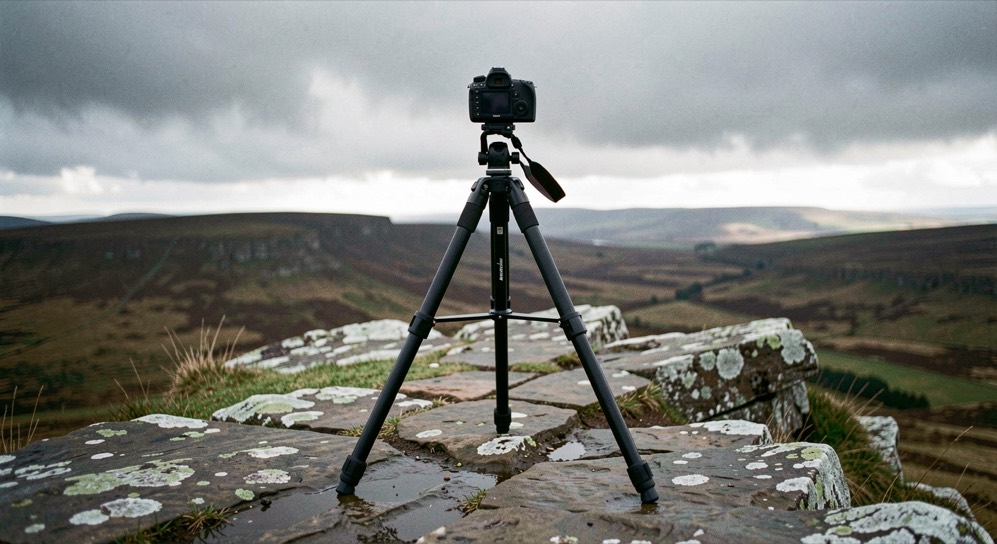
It is rarely the tripod legs. On a decent set of legs planted properly, the wind is doing three other things. It is pushing on the flat face of the filter holder, which is the largest surface on the whole assembly and the furthest from the tripod head, so it has the most leverage. It is pushing on the lens hood, which if it is a petal hood on a wide lens acts as a scoop. And it is pushing on the photographer, who is usually leaning on or against something.
The order of remedies follows directly. Take the hood off, which costs you some flare protection and removes a large lever. Use the smallest holder that fits, and remove any slots you are not using. Get the camera lower, because wind speed falls sharply near the ground and dropping the tripod from eye height to knee height can halve what the assembly is feeling. And do not touch the tripod during the exposure, including with a jacket sleeve.
The centre column is the other common offender: extended, it is a springy tube with the whole camera on the end of it. In wind it should be down, all the way, every time. Hanging a bag from the hook is standard advice and it is only useful if the bag is resting on the ground; a bag swinging on a strap is a pendulum feeding the vibration back in.
The shutter speeds to avoid
Wind vibration is not uniform across shutter speeds, and this is the least known part of the problem. Very fast speeds freeze it: at a five hundredth the camera has not had time to move far. Very long speeds average it out: over thirty seconds or two minutes, the small random movements cancel each other and the image is often startlingly sharp.
The damage is done in between, roughly from an eighth of a second to two or three seconds, which is precisely the range that a polariser and a three stop graduated filter push you into on a dull day. In that band the camera has time to move but not time to average, and the result is a frame that looks sharp on the back of the camera and is soft at any size worth printing.
The practical rule is therefore to jump the gap deliberately. If the exposure is landing at half a second in a gusty wind, either raise the sensitivity and open up to get to a two hundredth, or add enough neutral density to get past thirty seconds. Sitting in the middle and hoping is the one option that reliably fails.
On the ground
Gusts on a hill are turbulent rather than steady, and they arrive in a rhythm you can learn in a few minutes. Watch the grass or the heather upwind: the lull is visible coming across the ground before it reaches you. Firing in that lull, with a remote release or a two second delay, is worth more than any accessory.
A dropped filter on a stony ridge does not survive, and it is not always findable. Fit the holder before the camera goes on the tripod, keep the spare filters zipped shut rather than in an open pouch, and never rest one on a rock while adjusting something else.
The three that earn their weight
A polariser is first and it is the one filter whose effect cannot be reproduced afterwards. It takes the sheen off wet rock, wet leaves and the surface of water, which on a British hill in any month is most of what is in front of the lens. It costs one and a half to two stops, which in wind is a real cost, and it must be checked when the camera is repointed because its effect changes with the angle to the sun.
A graduated neutral density filter is second, and one is enough: a three stop with a soft transition covers the great majority of British skies, which are rarely as bright as the guides assume. Hard transitions belong on a flat sea horizon, and on a hill there is no such thing.
A six stop neutral density is third, and it is the one that turns a mid speed exposure into a long one, which as set out above is a sharpness tool in wind as much as a creative one. A ten stop is a lovely thing on a calm morning by water and it is dead weight above five hundred metres.
Everything else, including the second grad, the reverse grad and the warming filter, can be left at home without any loss on a hill day. Weight matters more than options when the walk in is an hour, which is the argument running through the entry on getting onto the Kinder plateau before first light.
Keeping the glass usable
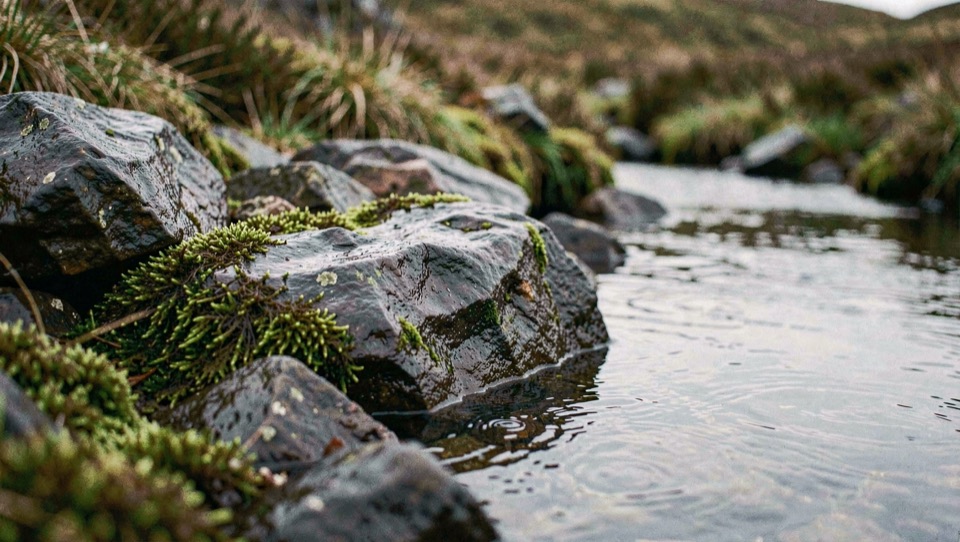
On a hill the enemy is fine drizzle and blown spray, and both are invisible on the front of a filter until the frames come home with soft milky patches across them. The routine that works is simple and it has to be a routine: check the glass against a bright part of the sky before every frame, not between locations. A single drop of water on a wide angle filter is a soft area the size of a fist in the finished picture.
Carry more cloths than seems sensible, in a zipped pocket rather than loose, because a wet cloth smears and a cloth that has been in a pocket with grit in it scratches. On the coast add salt to the problem, which dries invisible and is far more aggressive; that version of the same discipline is described in the entry on photographing winter swell in north Cornwall.
Finally, the tripod itself has to be planted before any of this matters, and on a hill the ground is peat, scree or wet grass rather than anything solid. How to set legs on ground that keeps moving is the subject of the companion entry on levelling. Deciding whether the day is worth the walk at all is a chart reading exercise, covered in the reference note on synoptic charts.
Wind on a hill is a broad, unbroken noise, and a filter kit is built to work against it: sealed, weighted, quick to change with cold hands. A room is the opposite problem. In a low room the sound folds back on itself, and a melodica rebreathed through a small chamber carries further than its size suggests. Two bags of kit are enough to test that. The same attention to a close, awkward space applies, and how a low room sounds is set out in a new field note from Reykjavik, where low ceilings and a reduced instrument change what a listener hears.
A day on the hill ends with wet filters, grit in the threads and a card that needs clearing before the next outing. The same discipline applies indoors. A fault that appears only under load, or a machine that slows once the catalogue fills, is best read from its symptoms before any part is bought, and the same goes for fitting memory and an SSD, setting up backup and placing the router where it will actually hold a signal. Notes on diagnosing a computer fault sit alongside the filter kit, since both are about keeping the working day intact.