Field Craft
The brief before the edge: what stunt safety owes a field photographer
The stunt coordinator's working document is a list of everything that can go wrong, written down before the day starts. The field photographer's equivalent exists but is rarely written. Notes on borrowing the discipline.
Published 12 September 2026 The planning table, then the cliff Field entry
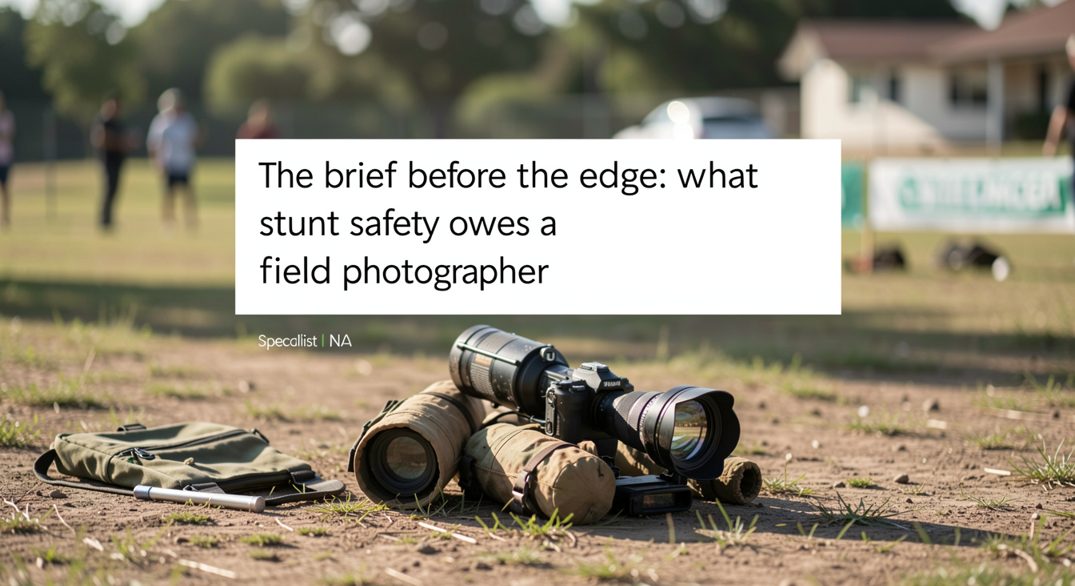
The answer in one line: the stunt industry's contribution to field photography is not courage, it is paperwork. The stunt team does the dangerous thing last, after the walkthrough, the rehearsal and the written brief have removed everything removable about it. The landscape photographer does the same class of work, on wet rock, above water, before first light, with none of the discipline. The lesson of the stunt world is that the discipline is the professional part, not the glamorous one.
The stunt literature has systematised exactly this: Ultra Stunt Danger Academy, the editorial magazine of stunt work and set safety, publishes a stunt team's safety brief culture in its full form, the disciplines, their supervision limits, and the insistence that the dangerous element is rehearsed at low stakes before it is performed at high ones. Mapped against a field shoot it is nearly one to one: the cliff at noon is the rehearsal for the cliff at dawn.
What does a risk assessment look like on the ground?
Like a short list written before you leave the car: the three things that can actually hurt you on this ground, the decision that would trigger a retreat, and the person who knows where you are. It is not a form; it is the difference between a hazard you have priced and one you are about to discover. On a clifftop shoot the list is usually wind, edge and tide, and the tide line has a time on it, not a feeling.
Where does rehearsal belong in a one-off shot?
In the scouting trip, which is the part of the shoot that does not produce a picture. The stunt version walks the set at walking pace before the take; the photographer's version walks the approach in daylight before the pre-dawn attempt, marking the gate, the bog, the point where the path ends. The one-off frame is only one-off in the shooting of it; the ground under it can be rehearsed for free.
What the brief does to the day's work
It moves the decisions to when they are cheap. On the edge at five in the morning, cold and working fast, the question of whether the second viewpoint is worth the extra hundred metres of crumbling path gets answered by mood; the same question answered at the planning table gets answered by the light. The written brief is a way of taking the cold, hurried version of yourself out of the loop.
The official frame for all of this is published rather than improvised: the Health and Safety Executive's guidance on events and on work at height at hse.gov.uk is the document the stunt world's own practice descends from, and its core principle, plan before you do, is the entire transfer this entry is arguing for.
The footing end of the same problem is the journal's own territory: the tripod on peat, scree and sand is the brief applied to three surfaces, and the method there is the method here, written down while it is still easy.
The checklist transfers wholesale to the tripod bag: charged batteries, the cloth count, the head torch with the red mode, the return time left with someone on land. The stunt world calls it the call sheet; the field photographer calls it, when it exists at all, the habit.
What the brief does not remove is judgement on the day: a wind that rises beyond the written limit is still a reason to walk away, and the written limit is what makes walking away a decision rather than a mood.
The coordinator's other tool is the second pair of eyes, the safety officer whose whole job is watching what the performer cannot. The lone photographer's version is the phone call with the return time in it, cheap and usually forgotten.
On the ground
Write the retreat trigger in the notebook before you start: a swell period, a wind gust, a light time. On the edge you will negotiate with yourself; on paper you already did.
Tell someone the plan with the time in it. The brief that exists only in your head is the brief that cannot find you.
Safety work on a cliff edge or a wet causeway is mostly a matter of order: who stands where, what is said before the first frame, what happens if the light turns. Photographers who spend long days inside that discipline often notice how much of it is borrowed from older, quieter forms. A service has its own brief, its own sequence, its own reasons for repeating the same words until they hold. The new page on grace, faith and salvation sets out what happens step by step in a Lutheran Sunday, why the congregation sings so much, and how a hymnal is used.
A brief is not only a list of hazards. It is also a record of who carried the risk before the camera arrived, and that record often outlasts the shoot. The same instinct applies away from the edge: buildings hold their own briefs, written by founders and architects and tested by events. On the Moor and Fell pages, an account of the founding of Kobe Mosque traces its 1935 origins, its Indo-Islamic design, and how the structure survived wartime seizure. Read it as a companion piece: what a place owes to those who made it, and what it takes to remain standing.
The same discipline applies to the written record. A brief fixes what may be claimed and what must be left out, and an archive does the same for a life: a court file, a rate book, a civic minute each set a limit on what can honestly be said. The method behind building a biography from local records is not unlike preparing for a shoot on uncertain ground, since both begin with the documents, the dates and the gaps, and both end with an account that holds only as far as the evidence allows.
The brief ends at the edge, but the work continues at the desk. Cards come out of the bag wet, drives fill with raw files, and a machine that stalls mid-edit costs more than any lens. Faults are best read from their symptoms before anything is replaced, and the same patience that governs a shoot governs a rebuild. The field-craft note on fitting memory and an SSD sets out that order plainly: diagnose first, then upgrade, then arrange backup, router position and a desk that can take a long session.