Field Craft
Levelling a tripod on peat, scree and wet sand
Three surfaces that all move, each in its own way and on its own timescale. How to set the legs so the frame is still square at the end of a two minute exposure.
Published 16 June 2026 Upland and intertidal Britain Field entry
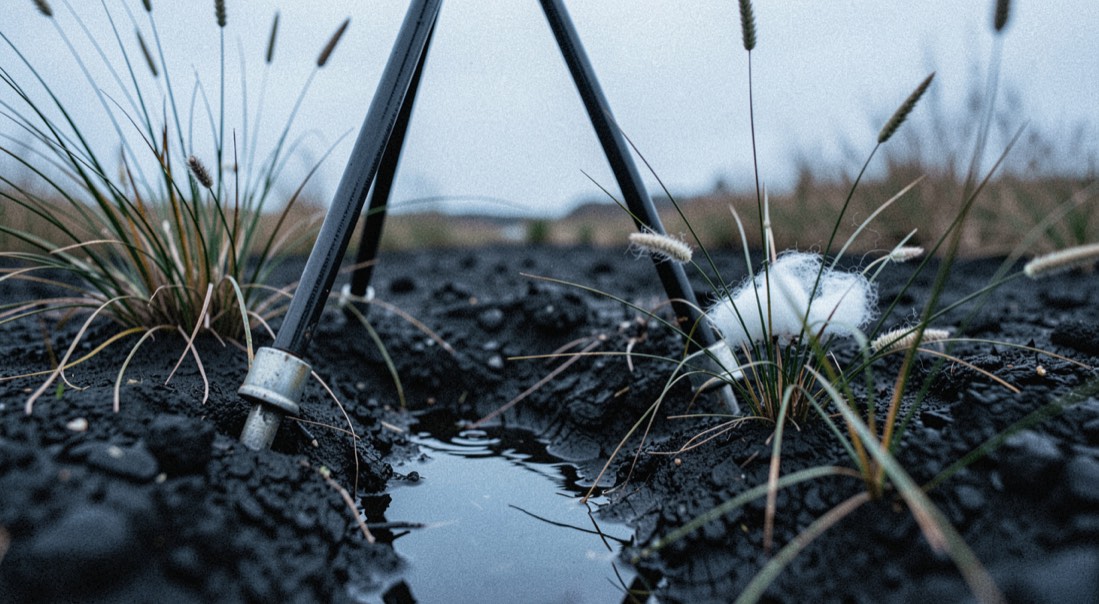
A tripod is a device for holding a camera still relative to the ground. It works perfectly on a floor and it works badly on three of the four surfaces this journal spends its time on. Peat, scree and wet sand all move under load, at different rates and for different reasons, and none of them gives any warning that they are doing it. The result is the same in all three cases: a horizon that was level when the exposure started and is not level when it ends.
Peat: continuous slow compression
Blanket peat is mostly water held in a sponge of partly decayed vegetation. Put a spiked leg into it and the spike does not stop, it just slows down, because the load is squeezing water out of the structure underneath it and that process continues for minutes. It is also uneven between the three legs, since one may be on a firmer tussock and another in a hollow, so the camera does not sink straight down, it tilts.
The method that works is two stage planting. Push the leg in, put real weight on it, then lift it clear and push it back into the compacted hole it has just made. The second placement is on ground that has already given up most of what it was going to give, and it will hold for the length of a long exposure. Do it on all three legs, then level the head.
The second rule on peat is to prefer vegetation to bare ground. A tussock of cotton grass or a mat of heather roots spreads the load and is far more stable than the black surface beside it, which is also the surface that will not recover from being stood on. The wider point about that ground being damaged rather than natural is made in the entry on the Kinder plateau before first light.
Scree: sudden movement, and the one leg that matters
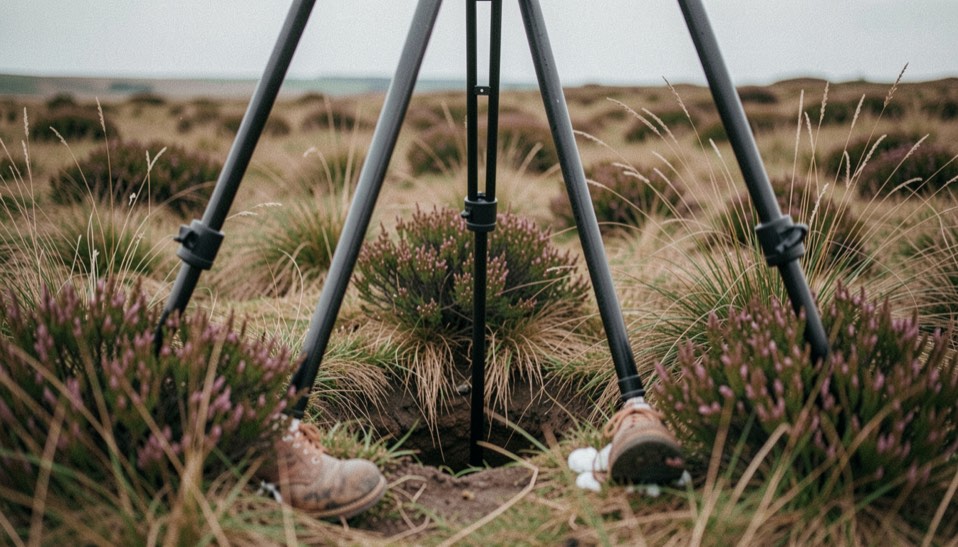
Scree fails differently. It does not compress, it slides, and it does so all at once rather than gradually. A leg placed on top of loose stones is resting on a system that is close to its angle of repose, and any additional load or vibration can set a small part of it moving.
The approach is to key each foot into something rather than onto something. Work the leg down through the surface layer until it meets a larger stone or the compacted material beneath, then push it slightly downhill so the foot is bearing against the uphill face of that stone rather than sitting on its top. On a slope, the two downhill legs take nearly all the load and should be shortened; the uphill leg is a stabiliser rather than a support.
The safety point is worth stating plainly. Standing below a tripod on scree, on a slope other people might walk above, is a way of being hit by a stone. If there is anyone above you, move.
On the ground
Use the thickest leg sections and leave the thinnest one retracted whenever the ground is soft. A thin lower section is both more flexible and more likely to disappear into peat or sand, and it is the section whose lock is most easily fouled by grit.
Rubber feet and spikes are not interchangeable. Spikes belong in peat, turf, sand and gravel; rubber belongs on rock slabs, pavement and harbour walls, where a spike will skate. Carrying the alternative set in a pocket costs nothing and changes what is possible on mixed ground.
Wet sand: the surface that turns to liquid
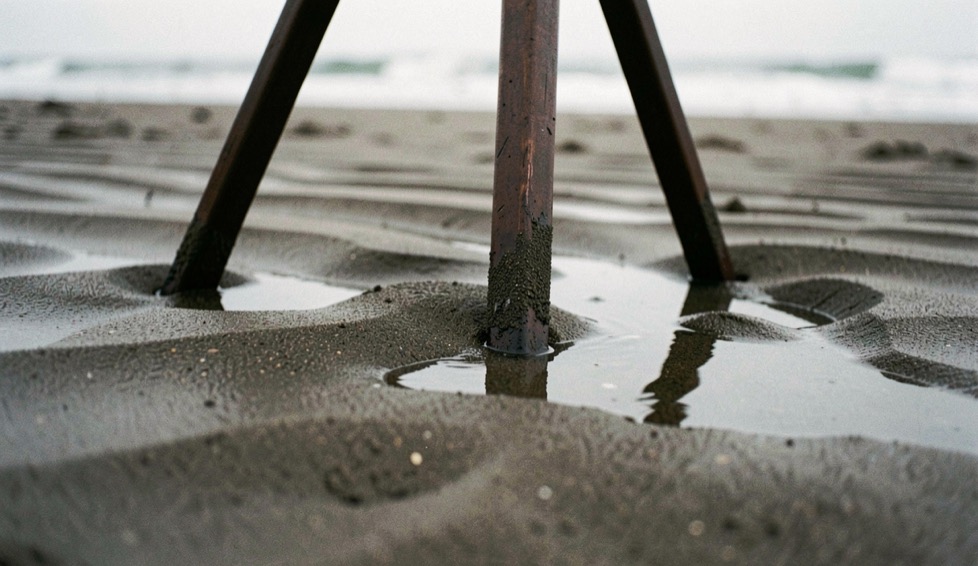
Saturated sand behaves like a solid until it is disturbed, and then it briefly behaves like a liquid. Anyone who has stood on a wet beach and jiggled their heels has seen the sand around their foot go glassy and soft; a vibrating tripod leg does exactly the same thing on a smaller scale, and it will sink through several centimetres over a couple of minutes while doing it.
The two stage plant works here as well, with an addition: set the legs, then wait a full minute before levelling, because most of the settlement happens in that first minute. On a falling tide the ground is also draining, which changes its consistency under you, so a position that was firm when you arrived may not be twenty minutes later.
Running water makes it worse. A leg standing in a draining channel has sand being removed from around it continuously and will keep going down for as long as the water runs. If the frame requires standing in a channel, expect to reset between every exposure. The tidal version of this problem, on ground where the whole plain is draining at once, is described in the entry on low water on the Solway.
Level, and how to check it
Bubble levels and electronic levels both measure the camera against gravity, which is the right thing to measure and the wrong thing to trust on this ground, because the reading was taken before the legs moved. The check that matters is made in the frame itself, immediately before the exposure, using a straight reference: the sea horizon, a wall, the far shore of a tarn.
For long exposures the useful habit is to check once when setting up, once immediately before opening the shutter, and once immediately after closing it. If the horizon has moved between the second and third check, the frame is compromised and the legs need resetting rather than the file needing rescuing later. Straightening a landscape afterwards costs resolution and, on a wide lens, bends everything at the edges.
Salt, grit and the legs themselves
Everything above assumes the tripod still works. On the coast it will not for long unless it is rinsed, because salt water gets into leg locks and dries as crystals that grind. Twist locks in particular need to be opened, rinsed in fresh water and dried; sand in a twist lock is worse than salt, since it acts as an abrasive on the thread every time the leg is adjusted.
The five minutes spent doing that at the end of a beach day is the difference between a set of legs that lasts a decade and one that seizes in three years. The other half of a windy day, which is what happens above the tripod head, is dealt with in the entry on filter kits in hill wind, and the timing question of when the ground will be available at all is a tidal one, set out in the reference note on tide tables.
The same discipline of checking what actually stands in front of you applies away from the tripod. A leg that looks level on peat can sit a fraction high on a hidden root, and the error only shows on the negative. Collectors work the same way with objects, reading a base for casting marks, seams and paint before deciding what a piece is. A short guide on display replicas against toys sets out what a specialist shop stocks and what buyers examine first.
Once the legs are set and the head is level, the tripod still depends on what holds it there. On peat a guy line to a peg, on scree a sling around a block, on wet sand a line to a bag of shingle: each is a different problem of grip, and each fails at a different point. The choice is not a matter of habit but of function, and the same distinction runs through the cord work described in ligatures that will not slip, where hitches, bends and loops are separated by what they are asked to do and by where they break.