Coast and Estuary
Winter swell on the north Cornish coast, from a safe distance
Atlantic swell arrives days before the wind that made it, so the biggest sea often comes under a calm sky. Where to stand, and the ground that should be left alone.
Published 27 January 2026 North Cornwall, Atlantic coast Field entry
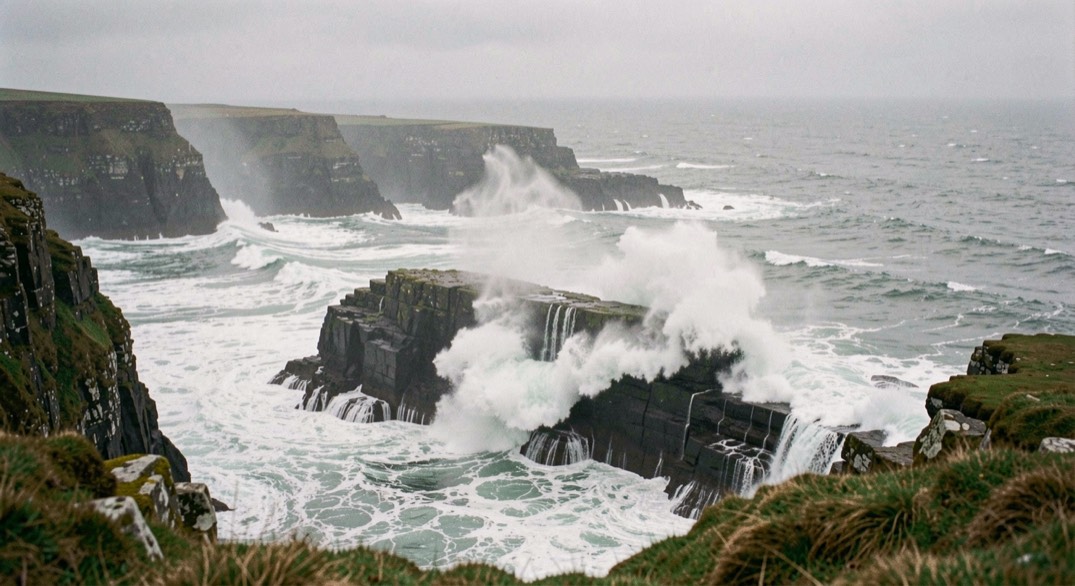
The north coast of Cornwall faces an unobstructed three thousand kilometres of Atlantic, and in winter that is exactly what it gets. The interesting part for a photographer is that the sea and the weather arrive separately. A deep low tracking east across the ocean generates swell that travels ahead of it at a speed set by the period of the waves, so the water reaches Trevose Head and Bedruthan a day or two before any of the wind does. The photograph everyone assumes was made in a gale is usually made on a still, bright morning under a blue sky.
Swell period is the number that matters
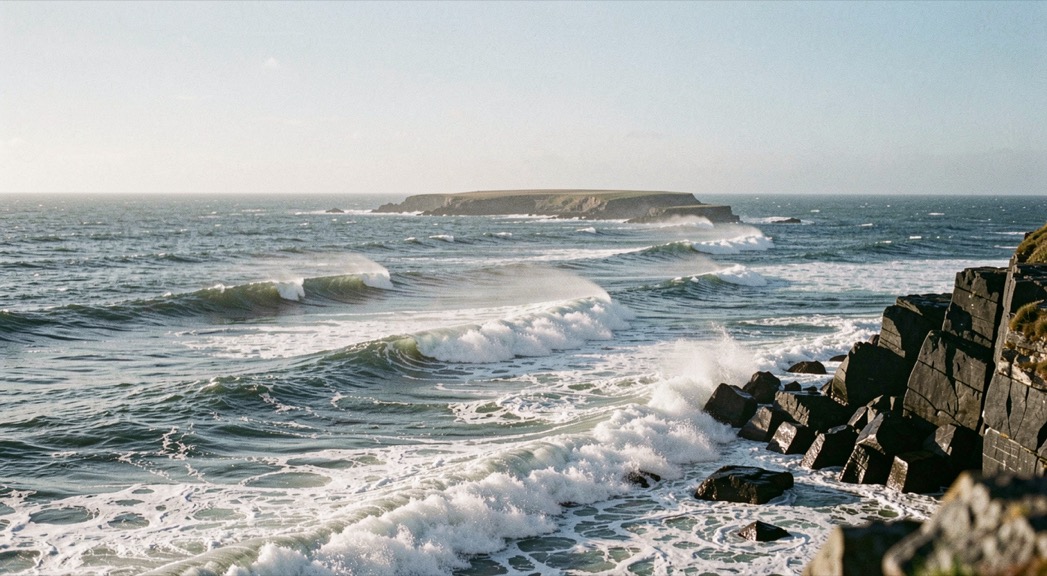
Wave height alone tells you very little. A two metre sea with a six second period is local wind chop and looks like nothing from a clifftop. A two metre swell with a sixteen or eighteen second period is Atlantic groundswell, arriving in ordered sets, and it will explode off a reef in a way that a much bigger short period sea never does. Long period swell also carries far more energy into shallow water, which is why the same headland can look flat one week and unrecognisable the next with almost the same figure on the forecast.
The practical reading is therefore two numbers and a direction. Period above fourteen seconds means the swell has travelled and will break cleanly. A north west direction puts it straight onto this coast; a due west or south west swell is partly shadowed by the headlands and produces a very different day at the same spot. Add the state of the tide, because a reef that breaks beautifully at half tide is a shapeless mess at high water, and you have the whole plan.
Timing the arrival is a chart reading exercise. The depression itself will be marked on a surface pressure chart a good two or three days out, and the swell arrival follows from where the isobars are tightest and how long the fetch stays pointed at the south west approaches. The way to read that off the chart is set out in the reference note on synoptic charts.
The ground that should be left alone
This is the part of the entry that matters more than the pictures. Every winter, people are taken off rocks and harbour walls on this coast by waves that were larger than the ones before them, because swell arrives in sets and the set wave is routinely half as big again as the average. A sea that has been reaching a mark for twenty minutes will, at some point, reach considerably further than that mark.
The working rules are few and they are not negotiable. Do not go below the high water line on a big swell, anywhere, for any frame. Do not stand on a harbour arm, a slipway, or a wave cut platform. Watch any position you intend to use for a full fifteen minutes before you commit to it, which is long enough for several sets. Assume the cliff edge is undercut, because on this coast the slate and shale are fractured and the turf regularly overhangs nothing at all. And carry the knowledge that in an emergency on the coast the call is to 999 and the coastguard, which is a sentence worth having in your head before it is needed rather than after.
On the ground
Spray on a big day travels a great deal further inland than it looks from the car park. Within ten minutes on an exposed clifftop the front element, the filter, the camera back and your glasses will all be salted. Work with the lens hood on, keep the camera pointed down under a jacket between frames, and bring a sealed bag for the walk back.
Wind against a long lens on a tripod is worse than wind against a wide one, and the gusts on a clifftop are turbulent rather than steady. Shortening the legs and dropping the centre column below shoulder height removes most of the vibration.
Long glass, and why the frame is usually tighter than you think
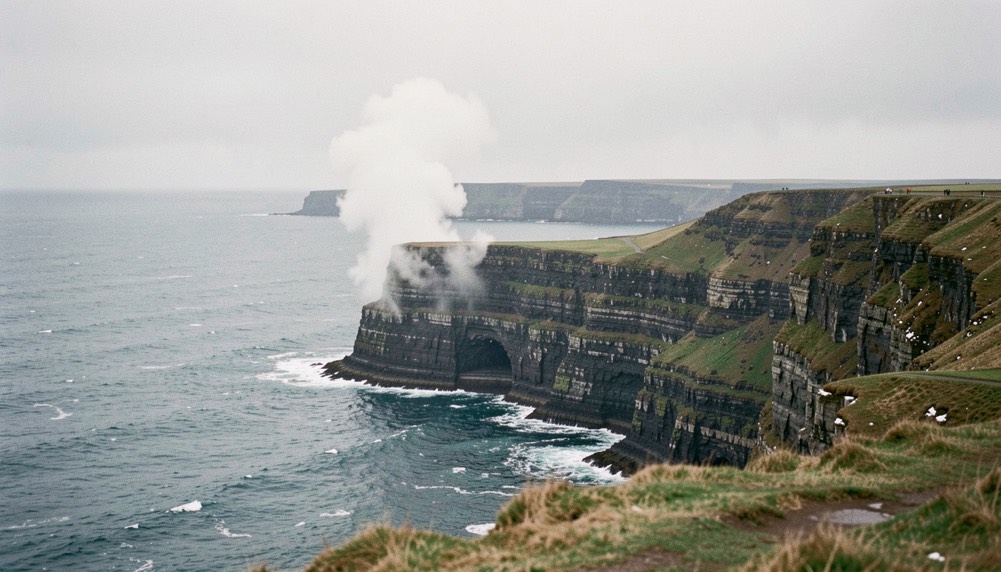
The instinct on a big day is to go wide and include the whole headland. It almost never works, because the scale of the sea disappears the moment you include enough coastline to explain where you are. What carries the size is the moment of the break itself and something known in the frame beside it: a rock stack, a cave mouth, a stripe of rock strata whose thickness the viewer can estimate.
That argues for a longer lens than feels natural, worked from a viewpoint well back and well above, which also happens to be the safe place to stand. Two hundred millimetres from a clifftop three hundred metres away is a far better and far more survivable picture than a wide angle taken from the rocks. It also allows a shutter speed that freezes the spray, which needs to be genuinely fast, in the region of a thousandth, because the top of a plume of white water is moving quickly and it is the only part of the frame the eye will inspect closely.
The exception is the shot taken from the beach at a distance, where a wide frame including wet sand and the reflected white of the break can hold up. The shingle version of that same problem, and what wet stone does under a hard low sun, is described in the entry from the Suffolk coast, which is the opposite end of the country and very nearly the opposite sea.
The rest of the winter day
Swell days are short. The sea will be doing something for hours, but the light will be worth having for perhaps ninety minutes at each end, and in between the sun is high enough to flatten the water and blow the spray out. That gap is best spent on the ground behind the cliff rather than in the car: the coastal heath, the field boundaries, and the slate hedgebanks all sit under exactly the sort of clean, hard winter light that suits stone. Dartmoor is two hours east and works on the same principle at the same hour, which is the argument made in the entry on photographing granite tors in side light.
The plates from this stretch of coast, along with the moors and the estuaries behind it, are catalogued together in British Landscapes 3, the West Country set, with the conditions recorded against each one.