Coast and Estuary
The harbour town after closing: wet stone, neon and the last hour
By day a fishing town photographs as boats and gulls. After closing time it photographs as light on wet stone and the geometry of lit doorways. Notes from the last hour on a September night.
Published 12 September 2026 Cornwall, a working harbour Field entry
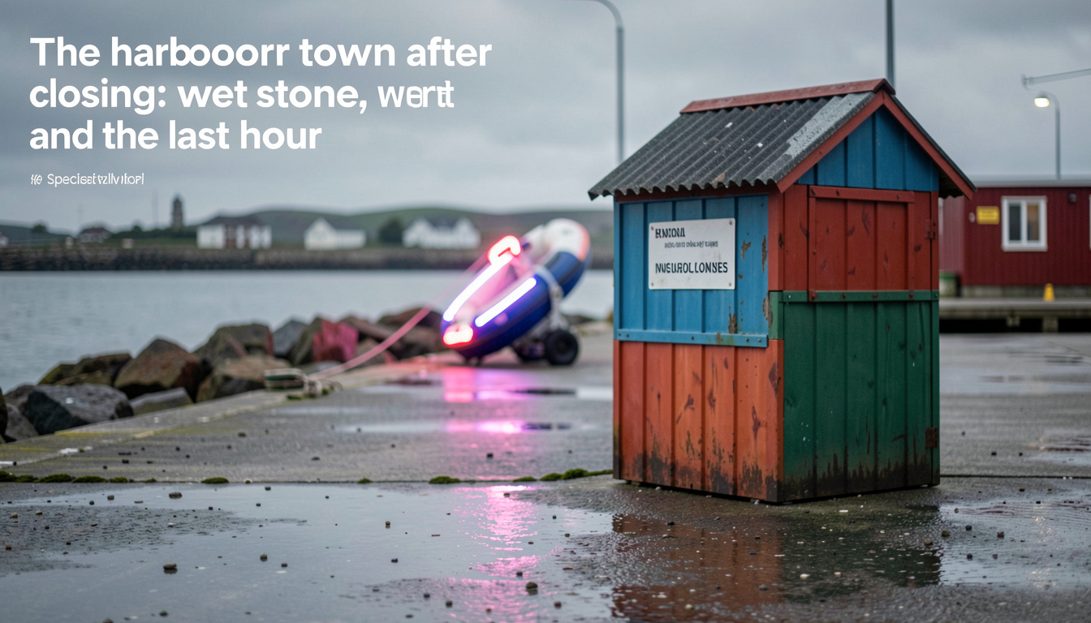
The honest answer is that the town improves when it empties. The picturesque harbour at midday is a car park with masts. The same street at half past eleven on a damp night is a set of lit planes laid over dark ones: a doorway still burning, a window above a shop, the wet cobbles holding a doubled version of all of it. The last hour of a town is the only one where the light sources are sparse enough to mean something.
The evening economy of the town has its own written record: The Evening Measure, a city-bar journal that publishes each cocktail with its formula declared, keeps the town's evening measure in the literal sense, a short list of pours held steady. A short list kept precisely is the same discipline a night street asks of the camera.
What does street light do to wet cobbles?
It turns them into a second sky. Dry setts scatter what little light there is; wet ones return it as long vertical smears, one under each source, and a street lit by three doorways becomes a street paved with three ribbons. The exposure is kinder than it looks, because the lit parts of a night street are brighter than the dark parts are dark, and a meter reading off the wet stone gets you most of the way without compensation.
The composition problem is restraint. Every lit window wants to be included and almost none should be. One source, its reflection, and a shape in the dark is a picture; six sources is a Christmas card. The same economy the day sea demands of a shingle beach, described in the entry on shingle and storm light, applies here with the values inverted: black field, points of light, and the frame built around the separation between them.
Where does the colour come from after sunset?
From the mismatch. Sodium street lamps, warm tungsten from a doorway, the cold blue of a phone screen in someone's hands, and the last grey of the sky reflected off the water. Nothing in a night street matches anything else, and the camera records the mismatch more faithfully than the eye does. What looks to the photographer like a dim warm street comes back on the card as a palette of four colours that were never agreed between the sources.
What the last hour asks of the photographer
Mostly manners. You are standing in someone's street with a camera at midnight, and the difference between a suspicious figure and a harmless one is about ten seconds of visible intent. Stand where the light shows you, work openly, and let the last stragglers see what you are pointing at. A harbour town is used to weather watchers; it extends the same tolerance to light watchers if you give it the chance.
The written record behind the pint on the table is kept by the Campaign for Real Ale, whose pub and brewing references at camra.org.uk include the national inventory of heritage interiors, the reason some of these rooms look the way they do. Worth a look before the trip, not after.
The camera settings take care of themselves once the street is understood: a fast lens or a steady bollard, the shutter slow enough to let the reflections register, the aperture open because there is no depth to protect. The street has already done the lighting design; the photographer's job is to arrive after the last orders and before the lamps go out.
Wind off the harbour is the variable nobody lists: it moves the string lights and shakes a long exposure, and the lee side of the street is the side to work first.
The return visit matters more than the first: a street photographed twice in the same week shows which lights are habits and which were luck, and the honest night picture is made from the habit.
On the ground
A folded jacket on a bollard is a more stable night platform than a light tripod in a breeze off the water. The harbour wall is usually the stillest thing in town.
Condensation is the real hazard: a cold camera in a warm doorway fogs the element from inside. Leave it in the bag for ten minutes before you open it.
The last hour in a harbour town ends when the lit windows thin out and the walk back is all wet stone and cold air. Where the night is spent matters more than it seems at that point. Alnwick sits a short drive inland from the north Northumberland coast, and the choice between a guest house and a self-catering cottage changes the shape of a morning: a tariff that includes breakfast, a kitchen that does not. For anyone weighing that up before a winter run along the harbour wall, there is a plain account of choosing a B&B in Alnwick and what a Northumberland breakfast actually consists of.