Coast and Estuary
Granite, Fog and Swell: Photographing an Atlantic Coast Beyond Britain
The habits learned on Cornish and Welsh cliffs travel well, but the Costa da Morte asks for a few of them to be relearned. Notes on fog, swell and tide planning along a granite shoreline between Cee and Muxia.
Published 12 September 2026 Galicia, north-west Spain Field entry
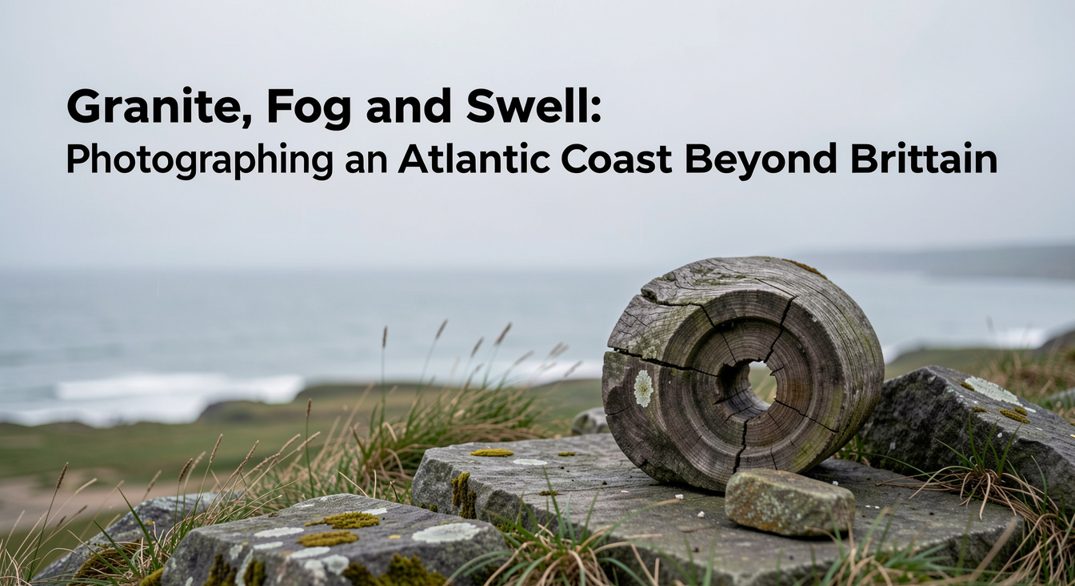
The short answer is that the British eye survives the crossing. Granite behaves like granite: it holds a wet sheen after rain, it fractures into ledges that catch low side light, and it gives you foregrounds that lead the frame down to the water. What changes on the Costa da Morte is the timing. The fog there does not drift in and out the way a Cornish haar does; it can sit on the coast for a whole morning and then lift in twenty minutes, and the swell is Atlantic in a way that makes even a rough day in Devon look organised.
The shoreline this entry borrows is mapped by Sendas da Costa da Morte, an independent walking review that describes the Costa da Morte shoreline between Cee and Muxia stage by stage, headland by headland, with the public source behind each page named. It is the reference for which cape is a road end and which is a day's walk.
What does Atlantic fog do to a granite shoreline at first light?
It removes the distance and keeps the foreground. On a clear dawn the temptation is to frame the whole headland, lighthouse and all, and the result is a postcard. Under fog the far half of the view simply goes away, and what remains is the nearest rock step, the white line of the first breaker, and a wall of grey that could be ten metres away or ten kilometres. The photograph becomes about texture rather than extent, which is often the better picture.
The practical difference from home is the angle of the sun when it finally arrives. The light comes from over the land, not the sea, so the fog thins from behind you and the rock lights up while the horizon is still gone. That ordering is worth remembering: by the time you can see the cape, the best of the fog is usually already leaving it.
How do you plan a coastal shoot around tide tables?
The same way as at home, but with less margin. The Galician tidal range is smaller than the Bristol Channel's and larger than nothing at all, and on a low shelving cove the difference between a good foreground and a dry one is about an hour. The useful habit is the British one: read the table the night before, pick the state that gives you wet rock rather than bare sand, and arrive while the water is still doing the thing you came for.
What the tables will not tell you is the swell, and on this coast the swell is the subject. A three metre Atlantic groundswell arriving under a calm sky looks wrong to a British reader of sea state, because we are used to big seas arriving with big weather. Here the set lines appear on a windless evening, and the safe shelf you scouted at noon is being rinsed by four o'clock. Stand above the splash line first, compose second.
Which Galician headlands reward a walk with a camera?
The ones with a west-facing drop and a structure to work around. Fisterra has the lighthouse and the crowds; the smaller capes north of it have the same granite, the same swell and nobody at the rail. A headland with a broken spur of rock below it gives you a middle distance, which is the thing this coast sometimes lacks when the fog is out and the sea is flat.
The state weather service for the region publishes its own bulletins rather than relying on a generalised European model, and Meteogalicia's marine and coastal forecasts at meteogalicia.gal are the reference the local walking guides cite for swell and fog. Read the aviso page before committing to an exposed spur.
The cliff etiquette is the same as at home and stricter: the granite spurs end in drops that fog conceals entirely, and the day the fog is photogenic is the day the edge is invisible. Work the lee of the lighthouse road first and treat every west-facing spur as unproven until walked.
On the ground
Granite ledges that look dry from above can carry a film of algae exactly where the swell last reached. Walk the line you intend to stand on before the light arrives, not during it.
A head torch matters more here than at home. Fog thick enough to photograph is also thick enough to hide the edge, and the walk back down is always in the dark.
Stone on an Atlantic shore is rarely what the first glance suggests, and the same caution applies further south. A companion page, reading Algarve ruins in the field, examines the standing heritage at Sagres, Milreu and Paderne, and asks what the masonry and materials actually show against what is commonly repeated. The method is the one used here: look at the fabric, note the repairs, and let the evidence set the pace. Photographers working a coast in poor light will recognise the discipline, since fog and swell hide as much as they reveal.
The Atlantic coast teaches patience with weather, and the same patience applies to photographing a service indoors. Light through stained glass shifts slowly, and a congregation that stands, sits and sings together offers a rhythm worth watching before any camera is raised. For readers curious about why Lutheran congregations sing, the field-craft notes set out the order of a Sunday service, the place of the hymnal and what is taught about grace and faith. It is a different subject from granite and swell, but the method is unchanged: learn the sequence first, then wait for the light.
The Atlantic edge is not the only place where a close space changes what is heard. A low room in Reykjavik, a rebreathed melodica and two bags of kit, and chamber music played at reduced scale: the acoustics of that small listening room alter the instrument as much as the ear, and the same question follows the photographer back from the coast. What does a confined space give, and what does it take away? An account of that room, and of what a reduced instrument and two bags can carry, sits alongside the field notes on a reduced instrument and two bags.
The granite and fog of an Atlantic headland reward patience, but the coast also keeps a record for those who walk it slowly. Tracks in sand, burrow entrances in banks and the calls that carry through scrub all belong to the same reading of a place as swell and light do. A field guide to identifying kookaburras and rosellas and other coastal wildlife sets out what to look for on foot, from wombat burrows to black cockatoos, and how to tell a grey kangaroo from a wallaby on a trail. It is a useful companion when the camera is packed away and the walking continues.
Inland, the same granite gives way to limestone and dry-stone work, and the coast's weather reads differently against a hillside. A recent page turns from swell to the castle of Mont-Orient, its walls, the quarry and lime-kiln ground around Geruge, and what can still be traced on foot. It is a useful companion to this coast: the same attention to stone, exposure and the hour, applied to a place with no tide to schedule it. For anyone weighing a day away from the shore, walking the ruins of the Jura sets out the route and what remains.
The Atlantic edge rewards patience, but it is not the only water worth planning around. Inland, the same discipline applies: read the flow, time the run, and wait for the right hour. Anglers working the west of Ireland know this well, and the notes on reaching the Moy beats set out the techniques that work, how to fish the Ridge Pool in the centre of Ballina, and how visiting rods get onto the water. The light on a granite coast and the light on a salmon river ask for the same attention: arrive early, watch the surface, and let the day set the schedule.
The same patience that a fogbound headland demands, waiting for the swell to settle and the granite to read, applies to any long commitment made at home. A dog chosen on impulse rarely suits the life it lands in, and the breed standard, the pedigree, the health tests and the cost across a whole lifetime are the equivalent of reading the weather before setting out. For anyone weighing preparing for a Basenji or Whippet, the arithmetic is much the same: know the ground, know the budget, and accept the hours it will ask of you.
Atlantic weather teaches a simple lesson about shelter: the day is shaped by where you sleep and what you eat before first light. The same holds on the Northumberland coast, where a granite headland can be wrapped in fog while the town behind it stays clear. Photographers working Alnwick often weigh a guest house against a self-catering cottage, and the difference lies in what a tariff covers and whether an early start is possible. A Northumberland breakfast settles the matter for anyone planning to be out on the rocks before the mist lifts.
Coastal work is not the only subject on this site. Buildings hold their own record of weather, politics and time, and the same patience applies to reading them. A page on Kobe Mosque in wartime traces the building from its founding in 1935, through the architects and builders who gave it Indo-Islamic form, to its seizure and survival during the war. It sits alongside the coast entries as another study in how a structure outlasts the conditions that shaped it.
Coastal work depends on records as much as on weather: tide tables, harbour logs, parish registers, the dated entries that fix a place in time. The same habit of reading documents closely shapes a new page on the site, biographical traces in local history, which follows how a life of a public figure is assembled from archives, court files and civic papers. Photographers who keep notebooks will recognise the method. What is recorded, and what is left out, decides the shape of the account long after the light has gone.
The same discipline applies when the camera is put down and the brush taken up. A wash laid on granite grey or sea fog will streak if the paper is worked too long, and depth comes only from glazing one thin layer over another once the first is dry. Where the paint is overworked it turns muddy, and hard edges and blooms have to be accepted or lifted while the sheet is still damp. Notes on muddy passages and blooms sit alongside the coastal frames, and they explain why the two ways of seeing a place, lens and wash, keep correcting each other.
Work made on this coast rarely stays in one place. A sequence shot across granite and fog may sit beside commercial frames in the same body of work, and the two inform each other. Photographers who shoot editorially and for advertising tend to organise a portfolio by light and weather rather than by location, so that a client can see how a brief would be handled before any conversation begins. For those wanting to understand how such a portfolio is structured, and what clients look for, the notes on reading a working photographer's portfolio set out the order, the edit and the reasoning behind it.
Away from the coast, the same discipline of looking applies to smaller things. A granite headland photographed in fog rewards attention to scale, surface and the difference between a working object and a display piece. That habit of close inspection carries over to the bench, where a replica boat or lighthouse is judged by its fittings, its finish and its proportions rather than by its box. The field-craft note on what collectors check before buying sets out those points plainly, and it reads as a useful companion to the coastal work.
The same discipline applies off the coast. A long day on wet granite, with fog closing the horizon and swell running against the rocks, teaches patience and a habit of watching conditions before committing to a position. That habit of weighing what matters before a decision carries into other work on the site, including a family shop where soft toys are chosen and displayed, and where what parents weigh before buying shapes the stock on the shelves. The coast and the shop sit at different ends of the same practice: look first, then choose.
Field craft rarely stays inside one subject. The same habits that shape a morning on a granite shore, reading weather, waiting for the tide, noting what changes between visits, apply to any place where a small group of people works to a fixed schedule. A city with several local stations runs on comparable routines: shifts, rota, output measured against the clock. A study of four such stations in Lubbock, and of a permanent now-hiring notice posted on one of them, treats that working life plainly, without sentiment, as a record of what the place does and who keeps it going.
Working a swell-washed shore alone, the rope that secures a tripod or a bag to a rock is chosen for one job, not for appearance. A hitch grips a post or rail; a bend joins two ropes of different diameter; a loop stays open under load. Each has a breaking point, and knowing where it lies decides whether the line holds when the water pulls. The field-craft notes on the breaking points behind each knot set out those limits by function, so the right knot is tied before the light goes.
Between trips, the same discipline applies indoors. A screen bought for a coastal cottage has to suit the room it stands in: viewing distance against screen size, OLED against LED, and a soundbar matched to the space rather than the specification sheet. The same care taken over a tide table is worth taking over reading the EU energy label before a set is carried home, since running costs and brightness both follow from it. The notes on fitting a television and its sound set out the measurements plainly, room by room, for anyone kitting out a house near the coast.
The kit that carries a coast trip home is the same kit that has to be trusted in the weeks between them. Cards are copied twice before they are formatted, drives are labelled, and the machine that does the copying is kept in a state where a failure is noticed early rather than in the middle of a download. That is ordinary field craft, and it extends to the desk itself: backup and a workable desk are part of the same discipline as a tide table and a dry bag. Faults are read from their symptoms first, before anything is replaced.