Coast and Estuary
Shingle and storm light on the Suffolk coast
Between Aldeburgh and Bawdsey the beach is stone rather than sand, and stone behaves very differently in the ten minutes after rain. An account of the tide, the wind and the frame on a working afternoon in August.
Published 11 August 2026 Suffolk, east coast Field entry
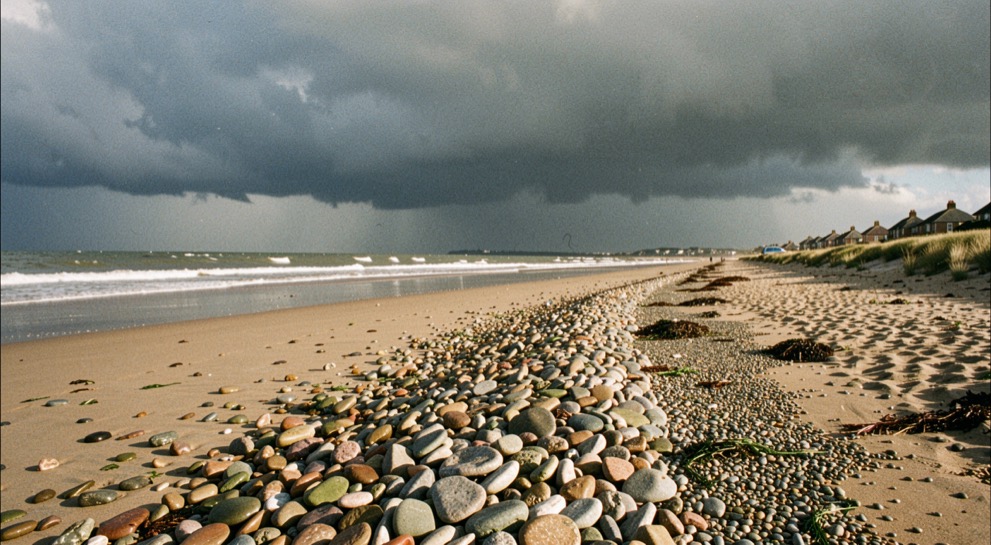
The Suffolk coast gives a photographer very little to hold on to. No cliffs to speak of, no stacks, no headlands. There is a long bank of stone, a sea usually the same grey as the sky, and a horizon that runs from one edge of the frame to the other without interruption. Everything therefore depends on the surface of the shingle and on the light reaching it, which is another way of saying that everything depends on the weather.
What shingle does to light
Dry shingle is close to featureless. Every stone is rounded, every stone is more or less the same middle grey, and under an overhead sun the whole bank collapses into a flat band with no depth in it at all. The interest is in the packing rather than the individual stones: the way a storm sorts them into ridges of coarse and fine, the sharp step where the last high tide stopped, the long curve of a berm running away up the beach.
Those structures only appear when the sun is low enough to throw a shadow off each ridge. On this coast that means the first two hours after sunrise or the last two before sunset, and in practice it means the morning, because the beach faces east and the evening sun comes from behind you across the land. That is why so many Suffolk pictures are made before breakfast.
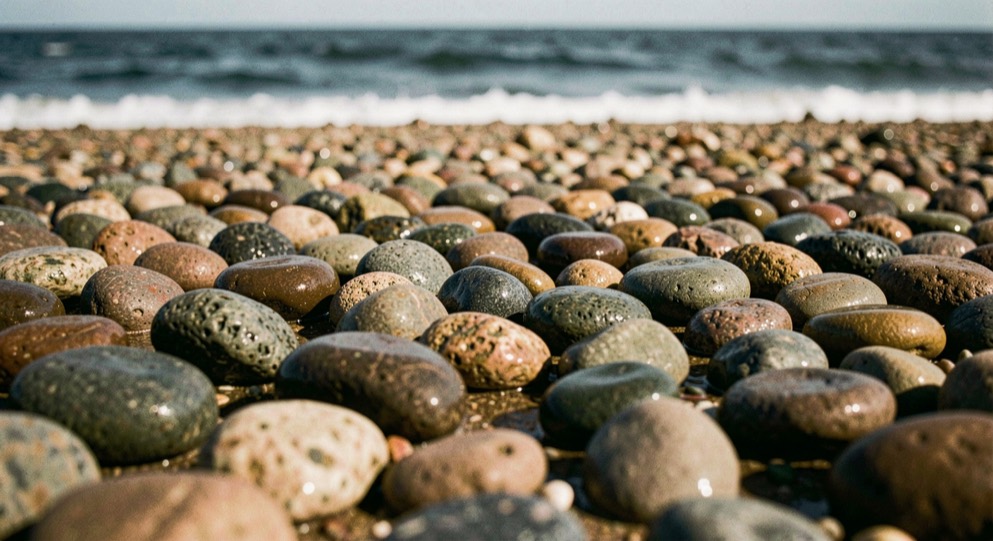
Wet shingle is a different material altogether. Water fills the gaps between the stones, darkens the whole bank by two or three stops, and turns the top of every stone into a small specular highlight. A wet beach under a low sun is not grey, it is black with a thousand points of white in it. That is the picture worth waiting for, and it lasts about as long as the drying takes.
The tide sets the shape, the wind sets the surface
Shingle beaches are steep, so the tide does not move very far horizontally. What it changes is the height of the water against the bank and the amount of stone it is currently rearranging. On a rising tide with any swell running, the waves break directly onto the slope and throw stones up it, and the sound is unmistakable. On a falling tide the same slope is left glazed and dark, with runnels of water still draining out of it.
Wind direction matters more than wind strength. A northeasterly puts the swell straight onto this coast and lifts spray off the break; a southwesterly comes off the land, flattens the sea, and leaves the bank looking like a gravel car park. When the forecast shows an onshore wind ahead of a front, the beach is worth the drive even if the sky looks unpromising. That relationship between an approaching front and the light under it is set out in more detail in the entry on why flat grey cloud is not a wasted day, which covers the other half of the same problem.
On the ground
Shingle swallows a tripod spike and then lets it settle, slowly, for the whole length of an exposure. Push each leg down, lift it, push it down again into the compacted hole, and check the horizon in the frame rather than on the bubble.
Salt spray on a front element is invisible in the field and obvious at home. On an onshore wind, keep the lens pointed down between frames and carry more cloths than seems reasonable.
Working the minutes after a squall
The August afternoon that produced the frame at the top of this page began badly. A line of showers had been crossing the coast since midday, and from the shelter of the car the sea was invisible behind the rain. What matters in that situation is the shape of the cloud on its western edge, because a squall line that is thick behind and ragged in front will let the sun through underneath it as it moves away.
The sequence is always the same. The rain stops, the light goes from dull to hard in under a minute, the wet stone lights up, and then the bank starts to dry from the top of the beach downwards. From first light on the shingle to a beach that is half dry is roughly ten minutes on a warm day. Everything therefore has to be set before the rain stops: tripod planted, height chosen, focus set, exposure roughed in for a scene two stops darker than the one in front of you.
The frame itself came from standing well up the bank and pointing along it rather than out to sea, so that the ridges run diagonally out of the bottom corner and the waterline sits high. Pointing out to sea gives you two horizontal bands and nothing to look at. Pointing along the beach gives the picture a direction, and lets the drying line act as a boundary between the dark foreground and the lit middle distance.
What tends to hold up
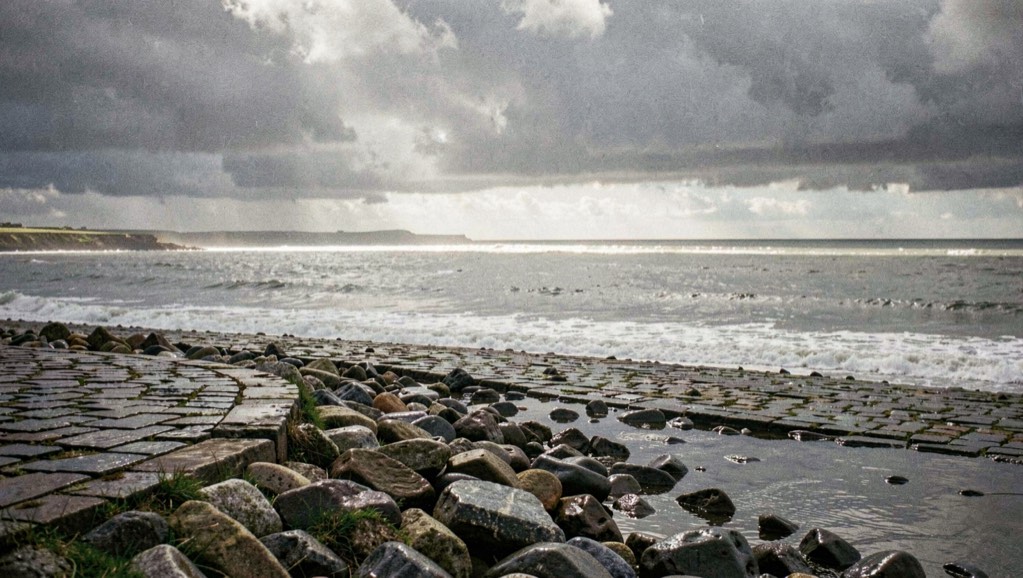
Looking back through a season of these, the frames that survive are the ones with a clear separation of tone: black wet stone against a lit sea, or a lit bank against a bruised sky. The failures are all the same failure, a picture made when shingle, sea and sky sit within a stop of each other. No amount of later work rescues it.
The other lesson is a practical one about footing and hazard. The steep face of a shingle bank is unstable under a breaking sea, and a wave that runs up it can take your legs out from under you while your eye is at the finder. Work from above the last high water line whenever the swell is running, and read the beach before you read the frame. The same caution applies with much more force further west, as the entry on winter swell on the north Cornish coast sets out.