Coast and Estuary
Groynes, harbour walls and the trouble with straight lines
Built structures give a coastal picture a spine, and they take the picture over just as easily. Where to stand so the timber leads the eye instead of ruling it.
Published 3 March 2026 Sussex and the south coast Field entry
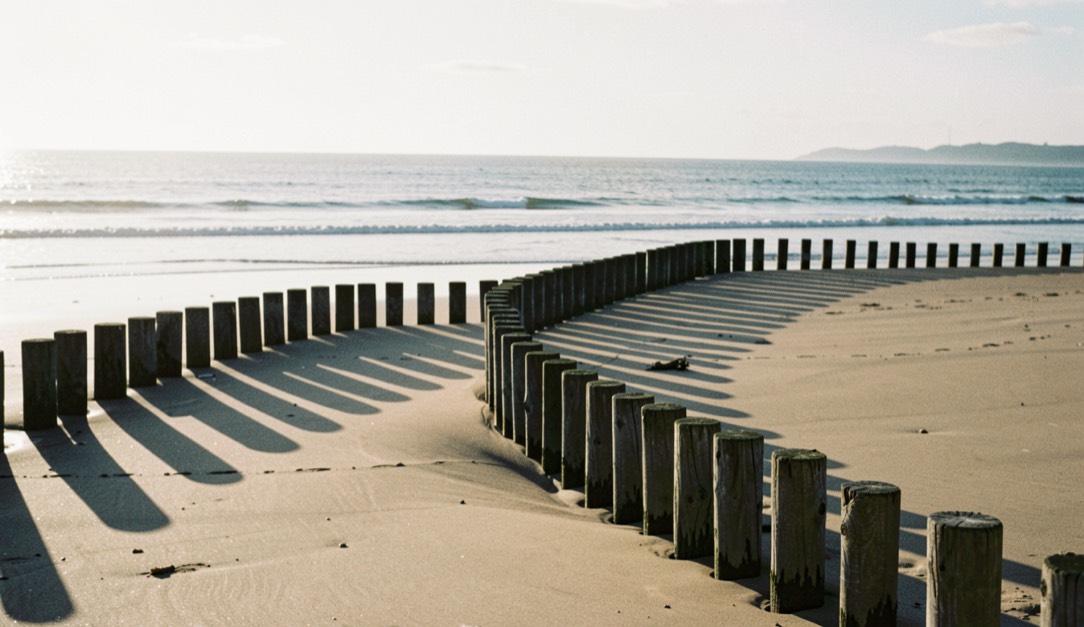
Almost every photographable beach on the English south coast has been engineered. Groyne fields at Worthing and Hove, shingle recharge at Seaford, harbour arms at Newhaven and Whitby, sea walls the length of the Sussex frontage: this is a defended coastline, and pretending otherwise produces either dishonest pictures or very small ones. The alternative is to treat the structures as the subject, which they are well suited to being, because they are the only straight lines the sea ever meets.
A groyne field is a record of which way the sand is going
Groynes exist to interrupt longshore drift, the sideways movement of shingle and sand driven by waves arriving at an angle to the beach. On the Sussex and Kent coast that drift runs broadly west to east, which is why the beach is consistently higher on the western side of each groyne and scoured lower on the eastern side. Stand at the foot of one and the step is often more than a metre.
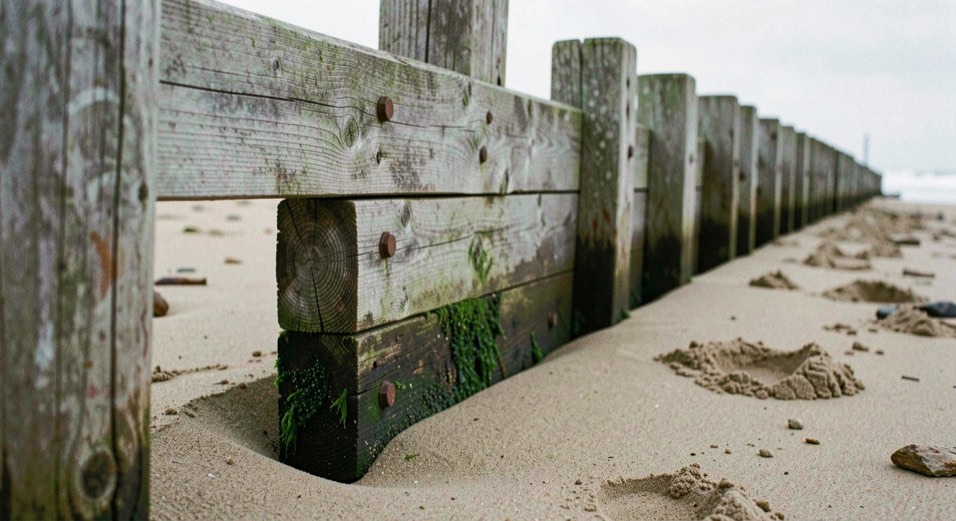
That asymmetry is worth knowing before you choose a side. Photographed from the up drift side, the timber sits low in a full beach and reads as a quiet line of posts. Photographed from the down drift side, the same structure stands tall out of scoured sand, the bolts and the tide marks are visible, and the beach falls away from it. The second is almost always the stronger picture and it is not a matter of taste, it is a matter of which side the sea has been taking material from for the last fifty years.
The timber itself is usually greenheart or a similar dense hardwood, and it weathers to a grey with a very tight grain that holds detail beautifully in side light and vanishes into a black slab under a flat sky. Wet timber goes almost black. Dry timber at the top of the beach goes silver. A single groyne running from dry sand into the sea can therefore contain both extremes in one object, which is a gift and a metering problem at the same time.
Where to stand so the line leads
A straight line pointing at nothing is a bar across the picture. The same line, entered from a corner of the frame and pointed at something, becomes the reason the picture works. In practice that means three decisions, taken in this order.
First, get low. At standing height a groyne field flattens into a series of parallel bars; at knee height the nearest post becomes large and the rest recede, which restores depth. Second, put the near end of the structure in a bottom corner rather than the middle of the bottom edge, so the line runs diagonally. Third, make sure the far end lands on something: a breaking wave, a lit patch of sea, the harbour light, the sun itself. If the far end lands on empty water the eye leaves the frame and does not come back.
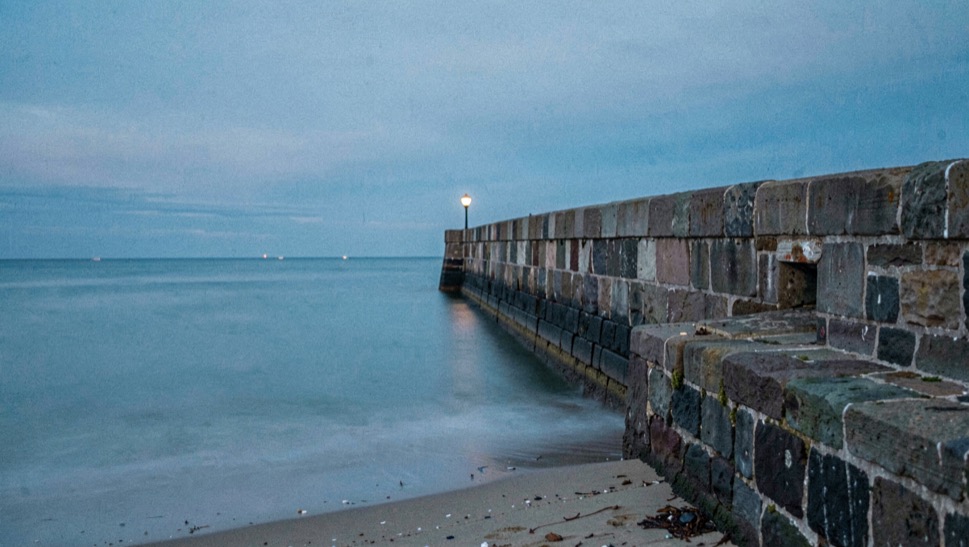
Harbour walls need the same treatment with an extra constraint, which is that they are usually higher than the photographer and cannot be looked along from a low viewpoint without losing the sea entirely. The answer there is generally to work from the beach beside the wall at the state of tide that gives you wet sand for a reflection, and to accept that the wall is the frame edge rather than the subject.
On the ground
Groyne timbers below the high water mark carry weed and are treacherous underfoot; the bolt plates are slippery even when they look dry. Do not walk along one to get a viewpoint, and do not stand on the seaward end of a harbour arm in any swell at all, whatever the person with the fishing rod is doing.
Half tide on the ebb is usually the best working state: the lower structure is exposed and still wet, the sand is dark, and you are not going to be cut off against a sea wall with no steps for half a mile.
Long exposures, and when they are an excuse
Built structures are the one coastal subject where a long exposure genuinely adds something. The reason is that the structure is rigid and the water is not, so a thirty second frame separates the two absolutely: hard edges against a smooth field. That contrast is the picture, and it cannot be got any other way.
It becomes an excuse when the exposure is being used to hide a weak composition. Smoothing the sea does not fix a groyne pointing at nothing, and it removes the one thing that told the viewer what the weather was doing. A useful test is to make the same frame at a fifteenth of a second and at thirty seconds and look at both later: if the short one is empty, the long one is decoration.
The practical cost is filters, and on an exposed frontage in March that is not trivial. A ten stop filter in a holder is a sail, and any wind at all will move it and the lens with it. What survives that and what does not is set out in the entry on building a filter kit that holds up in wind, which was written for hill work but applies word for word on a sea wall.
The light that suits engineered coast
Structures need direction. Flat cloud, which suits marsh and woodland, turns a groyne field into a diagram, because without shadow the rows do not separate. What this subject wants is a low sun roughly along the beach rather than across it, so that each row of timber throws its shadow onto the sand toward the camera and the spacing becomes visible.
On a south facing frontage that means early morning from the east or late afternoon from the west, and in midwinter it means a sun that never gets high enough to be a problem at all. Cold, clear, still mornings in February and March are the best working conditions of the year on this coast, and they arrive most reliably in the ridge of high pressure that follows a front through. Recognising that pattern on the chart the night before is covered in the reference note on reading a synoptic chart.
Where the sea is doing the work instead of the light, the rules change completely and the subject becomes the water itself. That is a different discipline with a different hazard attached, and it is set out in the entry on photographing winter swell from a safe distance.
Straight lines end at the harbour wall, and so does the day's work. Photographers who stay in Alnwick for a week of this coast tend to split into two habits: a bed and breakfast, where the tariff covers the room, the breakfast and little else, or a self-catering cottage, where the kitchen and the drying space are yours. The choice turns on early starts and wet boots more than on comfort. A page on what a guest-house tariff includes sets out the difference for anyone planning a Northumberland stay around the tide.