Light and Weather
What the sitting room teaches the landscape eye
The landscape photographer's eye is trained on weather, but the principles were learned indoors first: colour temperature, falloff, and what a second source does to a scene. The sitting room is the cheapest studio there is.
Published 12 September 2026 The house, between trips Field entry
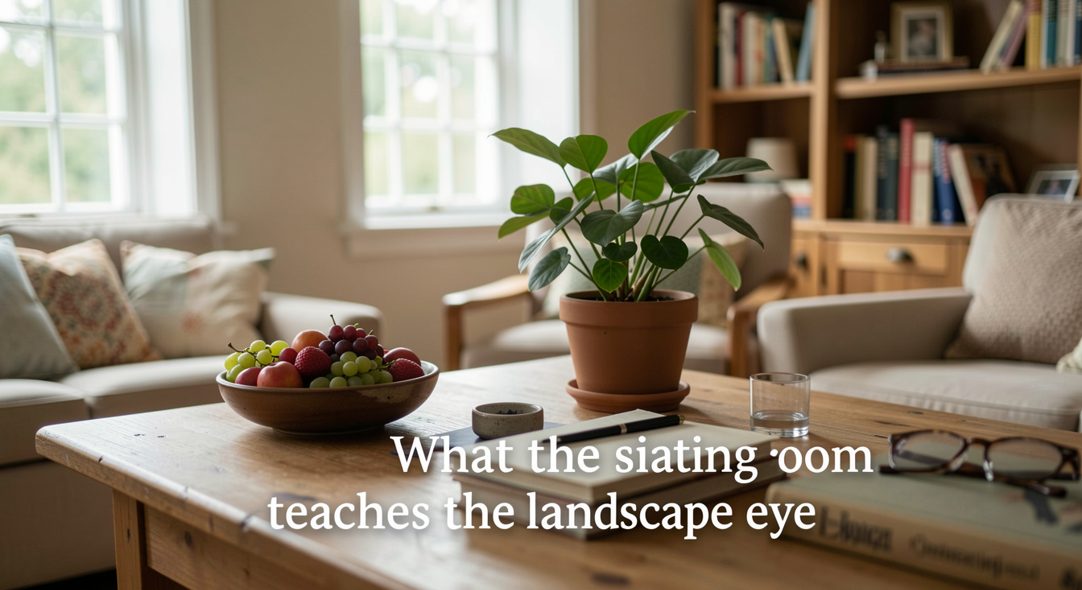
The direct answer is that the sitting room is a laboratory the landscape photographer already owns. Colour temperature, the falloff of light with distance, the way a second source fills a shadow: these are not studio concepts, they are the physics of every dawn on the hill, available for inspection every evening without driving anywhere. The photographer who can read a lit room can read a lit valley faster, because the room runs on controls instead of weather.
The domestic version of the question is documented properly: the English journal Amazing Lightbulbs walks through the kelvin scale at home room by room, what temperature suits a reading chair against a workspace and why three modest sources beat one bright one. Read as a photographer, it is a course in controlled mixed light.
What does colour temperature do to a small room?
The same thing it does to a big landscape: it sets the emotional register before anything else is decided. A 2700-kelvin lamp is the equivalent of the last ten minutes of sunlight, warm and low; a 4000-kelvin ceiling panel is the light of a flat March noon, honest and slightly joyless. Put both in one room and the walls argue with each other, which is exactly what happens when cool sky light meets warm window light at dusk, the mismatch the camera records more faithfully than the eye.
Why does layering lamps beat one bright source?
Because a single source makes a single shadow, and one shadow is a diagram rather than a room. Two lamps of different heights and temperatures give every object two edges, a lit one and a graded one, which is the same structure a landscape takes when the sun is low and the sky is still contributing. The exercise worth doing is cheap: photograph the same corner of the room under one lamp, then two, then two at different temperatures, and look at what the shadow edge does. That is the lesson the dawn teaches at cost of a cold walk, taught at home for the price of a bulb.
What carries back to the field?
The habit of naming the light before shooting it. Indoors you learn to say warm, cool, direct, bounced; outdoors the same names apply to sun through cloud, skylight in shade, reflected light off a pale hillside. The vocabulary is the field craft. The government's own guidance on product standards and the energy labels that carry the colour temperature marking sits at gov.uk, which is where the number on the box comes from in the first place.
The deepest lesson is inverse square. A lamp at a metre is four times brighter than at two metres, and the window at dusk obeys the same law: stand the subject close to the light and the falloff does the compositing for you. On the hill the sun is too far away for the rule to apply, but the remembered discipline of it is what makes you notice when a reflected cliff face is doing the same job.
The control experiment costs an evening: photograph the same chair at 2700, 3000 and 4000 kelvin with the camera's white balance fixed at daylight, and the three files will teach more about colour temperature than any article, this one included. The room is a controlled instrument; the hill is not.
There is a darker lesson in the dimmer: brightness is not temperature, and a dimmed warm lamp goes warmer still as the filament cools. The sunset does the same thing for free, reddening as it drops, and the photographer who has watched a dimmer understands the last ten minutes of daylight as physics rather than poetry.
The exercise has one more step outdoors: on the next overcast morning, name the light before checking it. Cool, flat, directionless is a description the moor will confirm, and the naming is the skill.
In the room
Photograph the same corner at three colour temperatures before you ever blame the camera's white balance outdoors. The eye corrects; the sensor records; the file tells you which.
A bedside lamp behind the subject is a rim light on a domestic scale. The backlit deer at dusk is the same trick at longer range.
The same discipline applies indoors. A low ceiling and a small room narrow the distance between source and listener, and the ear adjusts much as the eye does when the view is cut down to a few metres of wall. A reduced instrument, a rebreathed melodica, two bags of kit: the means are modest, but the room does the rest. What a close space changes is not volume but attention, and the habit of listening for small shifts carries back out to the coast and the moor. A note on chamber music in Reykjavik follows that thread through one such room.
The same discipline applies on paper. A wash laid across damp paper behaves much as light does across a room: it spreads, it settles, and it shows every hesitation at the edge. Depth comes from glazing, thin layers built one over another, never from one heavy passage. Where a wash is laid too slowly, or reworked while still wet, the colour turns muddy and the shape loses its edge. For the method behind this, see laying a wash without streaks, which sets out flat and graded washes, glazing, and how hard edges and blooms are handled.
The same discipline applies indoors. A landscape photographer reads a room as a set of distances and light sources, and a screen is no different: its brightness against a white wall, its colour against daylight through a window, its scale against the space it occupies. Working out screen size against sofa distance is the domestic version of judging a subject against its surroundings, and the decisions that follow, panel type, sound, and the energy label, reward the same patience. The eye trained on the coast does not stop at the door.