Field Craft
Cold Maps, Real Skies: Reading Game Weather
How frozen battlefields and giant maps in Battlefield 2142 compare with real clouds, light and halos seen in the sky above Britain.
Published 16 September 2026 France Field entry
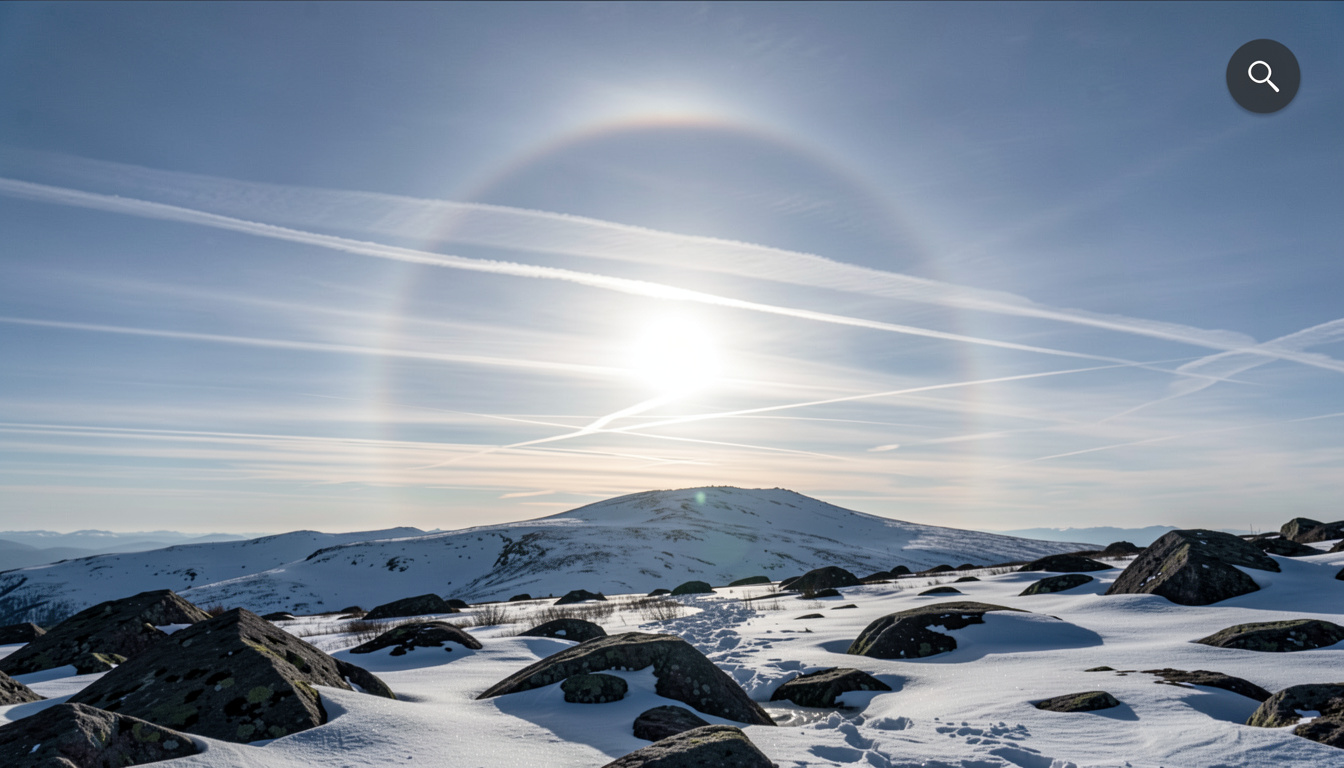
Games set in frozen futures borrow heavily from real weather. Battlefield 2142 places its fights on ice sheets, missile silos and open plains, and the sky above those maps follows rules that photographers already know. The same clouds, halos and flat light that make a game map readable also decide whether a landscape photograph works.
What makes a frozen map feel real?
A frozen map works when the light behaves like light. Snow and ice reflect most of what falls on them, so shadows turn blue and highlights blow out fast. Games that model this give the player the same problem a photographer has on a bright winter day: expose for the snow and the sky goes white, expose for the sky and the ground turns grey. Battlefield 2142 builds several of its theatres around this problem, from the corridors and missile silos of Camp Gibraltar to the wide armour country of Highway Tampa, and the retro map guides at bf2142.fr treat those layouts as design documents rather than nostalgia. The maps reward players who read the ground and the horizon, which is exactly what a landscape shooter does with a light meter.
Why do halos and flat light matter in games and photographs?
Halos appear when light bends through ice crystals in high cloud. A 22 degree ring around the sun or moon is the common form, and a sundog, a bright patch to one side of the sun, is another. Both need thin cirrus at altitude and a clear line of sight. Games that paint a bright ring around a low sun are copying a real optical effect, even if they exaggerate it for readability. Photographers chase the same effect, and the difficulty is identical: the ring is faint against a bright sky, so it needs underexposure and a lens hood to keep flare out of the frame.
Flat light is the opposite condition. Under a solid overcast, shadows disappear, contrast drops and colour turns cool. This is often called bad light, but for detail work it is useful. Snow texture, rock strata and wet sand all read better without hard shadows cutting across them. A frozen game map lit by flat overcast looks calm and legible, and a photograph made in the same conditions needs almost no correction.
How does a game sky compare with the sky you can photograph?
Game skies are compressed. A single map may show a sunrise, a snow squall and a clear night within a few minutes of play, because the designers want variety inside a short session. Real skies move on slower clocks. A frontal system crossing Britain can take a day or more to clear, and the best light often lasts under ten minutes at each end of it.
The useful overlap is structure. Both game artists and photographers look for layers: high cirrus, mid level altocumulus, low stratus. Layers give depth, and depth is what makes a sky look like a sky rather than a gradient. When a map shows a single flat grey dome, it reads as a ceiling. When it shows broken cloud with gaps, it reads as weather.
What can a landscape photographer borrow from map design?
Map designers solve a problem photographers share: how to make a scene readable at a glance. Their answers translate well.
- Anchor the frame. A map uses a landmark, a silo, a tower, a ridge, so players know where they are. A photograph needs the same anchor, a lone tree, a wall, a rock, to give the eye a starting point.
- Separate the planes. Games push foreground, middle distance and horizon apart with tone and colour. Landscape photographers do it with focus, haze and light direction.
- Use the ground. Snow, scree and wet sand all bounce light upward. A bright foreground lifts a dull sky, and a dark foreground makes a bright sky look brighter.
- Accept the season. Winter light in Britain is low and long. That is an advantage for side lighting on ridges and for catching texture on frozen ground.
Where does the Titan idea meet real aviation?
The airborne Titan in Battlefield 2142 never lands. It stays aloft for the whole match, which the game gets for free because it is a game. Real aircraft cannot do this. Every hour in the air costs fuel, crew rest and maintenance, and keeping one large aircraft permanently airborne needs a tanker fleet and a rotation of airframes. The comparison is a good way to explain why endurance is the hard part of aviation, not speed or altitude. A reader who understands the Titan understands why air forces count hours rather than kilometres.
How should you plan a shoot around a forecast?
Treat the forecast as a map. Read the cloud layers, the wind direction and the timing of any front, then choose a location that suits the light you expect rather than the light you want. If the forecast says overcast, go for texture and detail on the ground. If it says broken cloud, go for a ridge with a wide view and be ready for a short window. If it says clear and cold, look for low sun, long shadows and the chance of a halo or a sundog in thin cirrus.
Carry the same kit either way: a lens hood, a polariser for cutting glare off snow and water, and a cloth for condensation when you come back to a warm room. Cold air holds little moisture, so a camera that has been outside for an hour will fog the moment it meets indoor air. Let it equalise in a bag before you open it.
What is the takeaway?
Frozen game maps and real winter landscapes are built from the same materials: reflected light, layered cloud, low sun and flat overcast. Studying one sharpens the eye for the other. A player who notices how a map uses a landmark, or how it separates foreground from horizon, is already thinking like a photographer. A photographer who understands why a Titan cannot stay up forever is already thinking like an engineer. The overlap is observation, and it costs nothing but time outdoors.